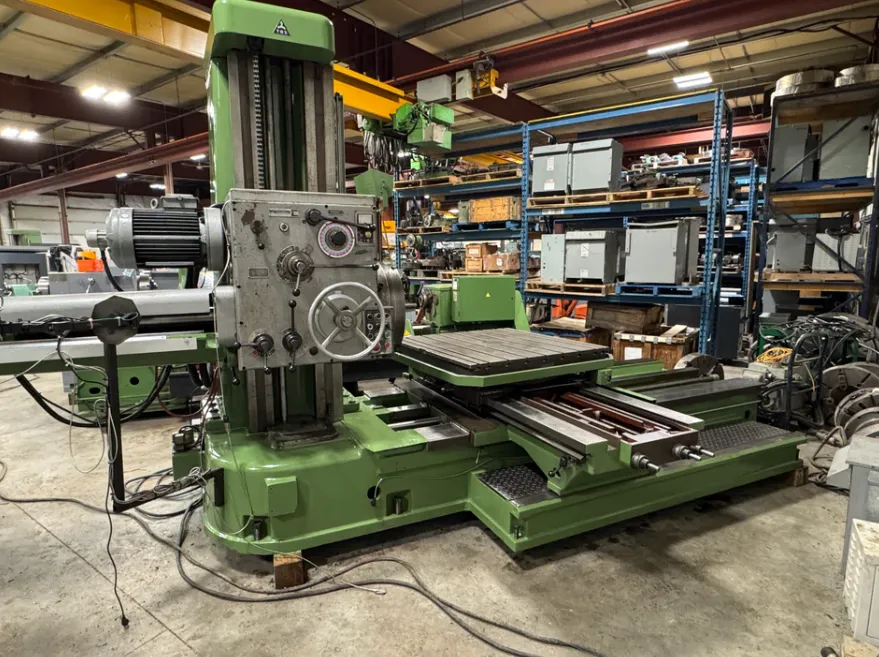
Purchasing a used boring mill is rarely a straightforward transaction. Unlike smaller machine tools, boring mills carry significant weight — both physically and financially — in any production environment. A machine that has been improperly maintained, overworked, or stored in poor conditions can introduce problems that won’t surface until it’s already on your shop floor, disrupting your workflow and straining your maintenance budget.
In Canada, the used machinery market moves at its own pace. Lead times on new equipment can stretch for months, and the economics of machining operations often push buyers toward the secondary market. That pressure can accelerate purchasing decisions in ways that bypass important evaluation steps. This guide addresses those gaps directly — not with generic advice, but with the specific considerations that matter when you’re evaluating a horizontal or vertical boring mill that has already spent years in production.
1. Understanding the Canadian Used Market Before You Commit
The used boring mill market in Canada is shaped by a combination of industrial activity cycles, regional equipment availability, and the operational history of the machines themselves. Manufacturing-heavy provinces tend to generate more inventory when facilities close, consolidate, or upgrade — and the condition of machines released from these environments varies considerably. Anyone researching boring mill for sale canada options should approach listings with the same structured discipline they would apply to commissioning a new machine, because the evaluation process is equally consequential.
There are reputable industrial equipment dealers across the country who provide inspection records, service history, and in some cases refurbishment documentation. Reviewing listings from established sources — such as those catalogued at boring mill for sale canada — gives buyers a useful starting point for understanding what’s available and how machines are typically described in the secondary market.
Why Market Context Shapes Your Evaluation Criteria
A machine that was operational in an aerospace sub-supplier facility has a very different wear profile than one used in general fabrication. Before you can assess mechanical condition meaningfully, you need to understand where the machine came from, what it was used for, and how frequently it was operated. This context determines which components are likely to show stress, which maintenance intervals matter, and whether the asking price reflects genuine value or optimistic positioning.
2. Spindle Condition and Its Effect on Accuracy
The spindle is the functional heart of a boring mill. It transmits cutting force, determines rotational accuracy, and ultimately defines the tolerance capability of the machine. Spindle wear in used equipment is inevitable, but the type and degree of wear tells you a great deal about how a machine was run and whether it can still hold the precision your parts require.
What Spindle Inspection Actually Involves
Inspecting a spindle goes beyond a visual check. Runout should be measured at multiple points — at the spindle nose and at a test bar extended to working depth. Any deviation beyond what your tolerance requirements allow is a disqualifying condition unless you’re prepared to invest in spindle reconditioning, which is a significant cost. Ask the seller whether the spindle has been reground, and if so, who performed the work and when. An undocumented regrind is less reassuring than it might appear.
3. Way and Slide Condition Under Load
Boring mills depend on precise linear motion across their axes. Ways and slides that have worn unevenly will cause positioning errors that compound across a workpiece, particularly on long bores or large-diameter work. This type of wear is often invisible in a casual inspection but reveals itself when the machine is under load or tasked with a tolerance-critical cut.
The Difference Between Surface Wear and Structural Compromise
Surface wear on ways is normal and manageable within limits. What becomes problematic is uneven wear caused by chronic overloading, improper lubrication, or infrequent maintenance. Machines that spent years running heavy structural components without adequate way lubrication will show localized wear patterns that a scraping or grinding reconditioning can only partially correct. Wherever possible, request that the machine be demonstrated under actual cutting conditions, not just a dry run.
4. The Lubrication History — The Check Most Buyers Skip
Lubrication is the most overlooked element in used machine tool evaluation, and it is responsible for more premature failures than any other single factor. A boring mill that was not lubricated consistently — or that used incorrect lubricant grades — will show internal damage that no external inspection can fully capture. Bearings, guideways, and gearbox components all degrade in predictable ways when lubrication is inadequate, but the damage accumulates silently over time.
Why Maintenance Records Matter More Than Machine Hours
Machine hours alone give you a rough proxy for use, but they say nothing about the quality of care the machine received. A machine with lower hours but no lubrication records is often in worse condition than one with higher hours and a consistent maintenance log. Ask specifically for lubrication schedules, oil change records, and any notes from service technicians. If none exist, that absence is itself diagnostic information — it tells you that maintenance was informal, which means the machine’s internal condition is genuinely unknown.
How to Assess Lubrication Health Indirectly
When records are unavailable, indirect indicators can help. Check the condition of lubrication fittings — if they’re corroded, missing, or clearly unused, lubrication was inconsistent. Inspect oil reservoirs for contamination, sludge, or unusual color. Listen to the machine under power for bearing noise or gearbox irregularities. These are imperfect proxies, but they’re far better than relying on a seller’s verbal assurances about how well the machine was cared for.
5. Electrical and Control System Integrity
Older boring mills often run on control systems that are no longer supported by their original manufacturers. This creates a specific category of risk: the machine may function perfectly today, but a failed control board or obsolete drive component could put it out of service for weeks while you source a replacement — or find an integrator willing to retrofit a modern control.
Evaluating Controls Before the Machine Moves
Control system evaluation should happen before any purchase agreement is signed. Power the machine on and cycle through all axes. Test rapids, feeds, and any automatic functions. If the machine has a CNC control, confirm that software is still backed up and that the controller has not developed any known fault histories. For older machines running proprietary PLCs, check whether the original documentation is included — without it, fault diagnosis becomes significantly more difficult.
The ISO standards for machine tool safety and control systems provide a useful reference framework when assessing whether an older control configuration still meets acceptable operating criteria, particularly if the machine will be used in a regulated production environment.
6. Structural Integrity of the Column and Table
The column and table of a boring mill carry the full mechanical load of every operation. On horizontal boring mills in particular, the column must remain perpendicular to the table across its full travel range. Any deviation — caused by crash damage, improper installation, or thermal distortion from years of operation — affects every part the machine produces. This is not a problem that lubrication or control upgrades can fix.
What Crash History Looks Like and Why It’s Hard to Detect
Crash damage is not always obvious. A machine that experienced a significant impact may have been returned to approximate alignment without the underlying structure being properly assessed. Look for evidence of repairs on the column base, non-factory welds, or mismatched paint on structural sections. These are indicators that the machine absorbed an impact at some point. If the seller cannot account for the machine’s history through a specific facility or operator, treat this as an open question that warrants professional inspection before purchase.
7. Reconditioning Costs and Whether They’re Already Priced In
Every used boring mill requires some degree of reconditioning. The question is not whether work is needed, but how much, what it involves, and whether the purchase price reflects that reality honestly. Buyers who focus only on the listed price without projecting reconditioning costs often find that their total landed cost exceeds what a newer or better-condition machine would have required.
Building a Realistic Cost Model Before You Negotiate
A practical approach is to walk through the inspection findings item by item and assign a realistic cost range to each required repair. Spindle reconditioning, way grinding, electrical updates, and control retrofits each carry their own cost profiles depending on machine size and regional service availability. Once that total is estimated, subtract it from what the machine would be worth in fully reconditioned condition — and that gap is your maximum negotiating room. Sellers who resist this analysis are typically aware that the machine’s condition does not support the asking price.
Final Considerations Before You Sign
Buying a used boring mill in Canada requires more structured diligence than most equipment purchases. The machines are large, complex, and expensive to move — which means that a poor purchasing decision is difficult and costly to reverse. The seven areas covered in this guide are not exhaustive, but they represent the evaluation points that most consistently separate buyers who are satisfied with their purchase from those who aren’t.
Give particular attention to lubrication history. It is the area buyers most frequently overlook and the one most reliably connected to unexpected failures after commissioning. Combine that with a clear-eyed assessment of reconditioning costs, and you’ll have a much more accurate picture of what the machine will actually cost you — not just what it costs to acquire.
The used boring mill market does offer genuine value when approached carefully. Machines that have been well maintained and honestly represented can deliver years of reliable service at a fraction of new equipment cost. The goal is not to avoid the secondary market — it’s to enter it with the information and discipline to make a sound decision.

I’m Leo Knox, the wordplay wizard behind WordsTwists.com where I turn everyday meanings into funny, clever, and creative twists. If you’re tired of saying things the boring way, I’ve got a better (and funnier) one for you!