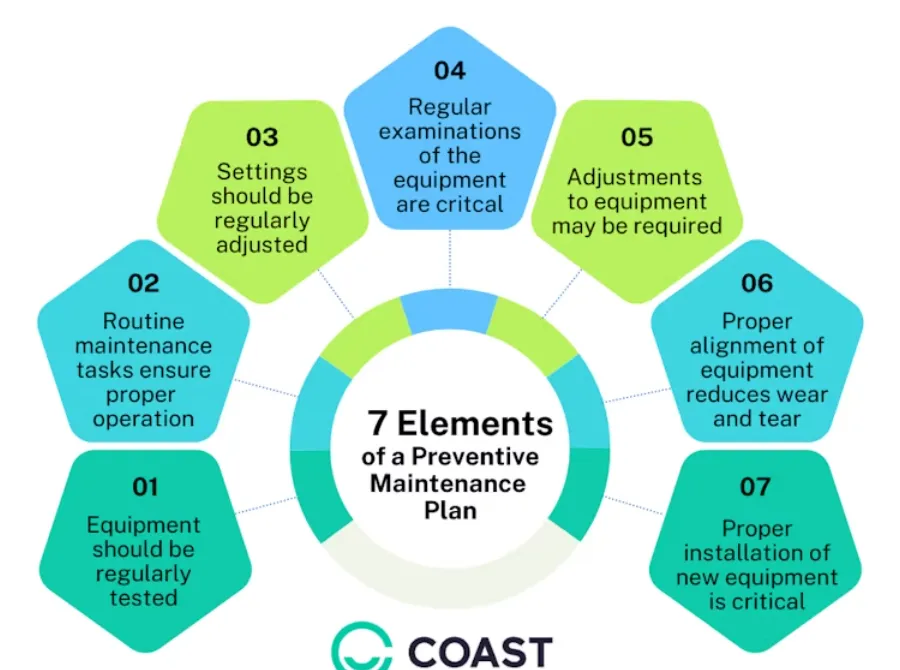
Stone fabrication shops operate under consistent mechanical pressure. Saws, CNC routers, polishers, and waterjet systems run through demanding material day after day, and the cumulative stress on each machine is easy to underestimate until something stops working. For most shop owners, unplanned downtime is not a minor inconvenience — it disrupts job timelines, strains labor schedules, and creates ripple effects that take days or weeks to fully resolve.
A preventive maintenance schedule changes the relationship between a shop and its equipment. Instead of responding to failures, the shop anticipates wear, tracks component behavior, and addresses problems before they become costly. This kind of structure requires discipline, but it also requires a clear framework that fits the actual operating rhythm of a stone fabrication environment. This article outlines how to build that framework, from the ground up, in a way that is practical and sustainable for a working US shop.
Why Preventive Maintenance Is a Business Continuity Decision
Preventive maintenance is not simply a mechanical routine. It is a decision about how a shop manages operational risk. Every machine in a stone fabrication facility represents a bottleneck if it fails. A CNC bridge saw that goes down mid-production does not just pause one job — it affects everything queued behind it. The cost of reactive repairs typically exceeds the cost of scheduled maintenance, not only in parts but in labor hours, subcontracting, and missed deadlines.
For shop owners who are building or refining their approach, consulting a structured Stone Fabrication Machinery Service guide provides a useful baseline for understanding what kinds of maintenance each machine class requires and what intervals are generally appropriate for high-use fabrication environments. Having that reference alongside your internal schedule helps close gaps that in-house staff may not immediately recognize.
The business case for preventive maintenance also includes equipment lifespan. Machines that receive consistent attention tend to hold their calibration longer, produce cleaner cuts, and require fewer major component replacements over time. These outcomes directly affect product quality, which in turn affects shop reputation and the ability to hold consistent pricing on labor-intensive jobs.
Understanding the Cost Structure of Reactive vs. Preventive Maintenance
When a machine breaks down unexpectedly, the shop absorbs multiple costs at once. There is the cost of diagnosing the failure, sourcing replacement parts — which are sometimes backordered — paying for emergency service labor, and absorbing the production loss during the repair window. In many cases, the shop also absorbs the cost of rescheduling customer jobs or expediting other orders to compensate.
Preventive maintenance spreads these costs out over time in a controlled and predictable way. The shop knows when components are due for inspection or replacement, can order parts in advance, and can schedule service work during lower-production windows. This predictability is especially important for smaller shops where cash flow is closely managed and unplanned expenses create real pressure on operations.
Mapping Your Equipment and Defining Maintenance Tiers
Before any schedule can be written, a shop needs an accurate inventory of its machinery and a realistic sense of how each piece of equipment is used. Stone fabrication shops vary significantly in the mix of machines they run, and a maintenance framework needs to reflect the actual workload rather than a generic template. A shop running a high-volume waterjet system five days a week faces different maintenance demands than one using the same machine two days a week on smaller custom jobs.
The practical starting point is a full equipment list that includes each machine’s make and model, its primary function in the production workflow, its average daily or weekly operating hours, and its current service history. From that list, the shop can begin assigning each machine to a maintenance tier based on how critical it is to production output and how frequently it operates.
Defining Critical, Supporting, and Ancillary Equipment
Not every machine in a shop carries the same operational weight, and the maintenance schedule should reflect this distinction. Critical equipment includes any machine that, if it stopped working, would halt primary production — typically the CNC saw, the edge polisher, or the waterjet, depending on the shop’s core output. These machines warrant the most frequent inspection intervals and the most detailed maintenance logs.
Supporting equipment includes machines that assist production but where manual workarounds or alternative processes are possible if the machine is down for a short period. Ancillary equipment covers tools and systems with limited direct production impact, such as dust collection units or secondary grinding tools. Categorizing machines this way ensures that maintenance effort and resources are allocated in proportion to actual operational risk rather than spread equally across all equipment regardless of priority.
Structuring the Schedule by Interval Type
A preventive maintenance schedule is built around intervals — the defined periods at which specific tasks are performed. Interval-based thinking prevents the common problem of maintenance being done only when something looks wrong or when a technician happens to notice an issue. It also creates accountability because there is a written record of what was done and when.
Intervals in stone fabrication environments typically fall into daily, weekly, monthly, and quarterly categories, with some components warranting annual professional service. The key is matching the interval to the actual wear rate and operating conditions of each machine, not applying a uniform schedule across all equipment.
Daily and Weekly Tasks: The Foundation of Mechanical Health
Daily maintenance tasks are usually the simplest and fastest to perform, but they carry significant long-term value. Cleaning debris from machine beds, checking coolant levels, inspecting blade condition before production begins, and verifying that safety guards are properly seated all take a few minutes but directly affect how the machine performs and how long components last. In stone fabrication, particulate buildup is a persistent issue. Fine dust and slurry residue can work into bearings, seals, and guide rails over time, causing premature wear that would not occur with consistent cleaning.
Weekly tasks extend this logic into slightly more detailed inspections. Checking belt tension, inspecting vacuum cups and hold-down systems, examining coolant lines for blockages, and verifying spindle behavior under load are all tasks that can catch early signs of wear before they become functional problems. Weekly inspections are also an appropriate moment for operators to document any unusual sounds, vibration patterns, or output quality shifts they noticed during the preceding days.
Monthly and Quarterly Tasks: Deeper System Checks
Monthly maintenance moves into component-level inspection. This is when the shop examines items like lubrication points, electrical connections, alignment of cutting heads, and the condition of wear parts that do not visibly degrade on a weekly basis. For machines with automated controls or digital positioning systems, monthly checks should include verifying that calibration has not drifted, which can happen gradually as components settle or experience thermal expansion over repeated use cycles.
Quarterly maintenance typically involves more significant disassembly and inspection. Spindle runout checks, coolant system flushes, detailed examination of drive components, and inspection of machine frames for stress or movement all fall into this interval. Many shops also use quarterly maintenance windows to coordinate with outside stone fabrication machinery service providers for tasks that require specialized tools or expertise beyond what the in-house team can reasonably perform. According to the Occupational Safety and Health Administration, documented maintenance procedures are also a key element of workplace safety compliance in manufacturing environments, which adds another practical reason to formalize these intervals in writing.
Assigning Responsibility and Creating Accountability
A maintenance schedule is only useful if the right people are responsible for carrying it out and if there is a clear system for documenting completion. In many shops, maintenance responsibility is informal — it gets done when someone remembers or when a problem becomes obvious. Formalizing responsibility means assigning specific tasks to specific roles and building documentation into the workflow rather than treating it as optional.
Operators who use a machine daily are often best positioned to handle daily and weekly maintenance tasks. They are familiar with how the machine normally behaves, which makes them effective at spotting changes early. Monthly and quarterly tasks may be better assigned to a lead technician or supervisor who can approach the inspection with less familiarity bias and more structured attention.
Building a Simple Log System That Gets Used
Maintenance logs do not need to be complex to be effective. A straightforward log records the date, the task performed, the person who performed it, any observations made during the inspection, and whether any follow-up action is needed. This record creates a running history for each machine that becomes valuable over time — both for identifying patterns in wear and for making informed decisions about when to invest in repairs versus replacement.
Digital log systems, even simple spreadsheets, make it easier to review history and flag upcoming intervals. Some shops integrate maintenance tracking into their existing job management software. The specific format matters less than consistency. A log that operators can complete quickly and clearly is more useful than a detailed system that rarely gets filled out accurately.
Integrating Professional Service into the Schedule
Preventive maintenance that is handled entirely in-house has real limits. Some tasks require calibration tools, specialized training, or parts access that a typical shop does not have on hand. Integrating professional stone fabrication machinery service into the annual schedule ensures that these deeper technical needs are addressed systematically rather than only when a problem forces the issue.
The timing of professional service visits should be planned around the shop’s production calendar. Scheduling service during slower production periods or between large projects minimizes the operational impact and gives the service technician adequate time to work thoroughly rather than being pressured to rush.
What to Expect from a Professional Service Visit
A professional service appointment for stone fabrication equipment typically covers tasks that go beyond routine inspection. This includes full geometric alignment checks, spindle bearing assessment, drive system evaluation, control system diagnostics, and a review of any wear patterns the operator logs have flagged over the preceding months. The value of these visits is not only in what gets repaired but in what gets documented — a professional technician can identify developing issues that are not yet causing visible problems, which gives the shop time to plan for the repair rather than react to a failure.
Shops that maintain consistent records from both in-house and professional maintenance sessions build a detailed mechanical history for each machine. That history informs replacement planning, warranty tracking, and resale value assessments over the long term.
Closing Thoughts: Building a Schedule That Holds
A preventive maintenance schedule works when it is realistic, clearly assigned, and consistently followed. The framework described here is not a rigid formula — it is a set of principles that shop owners can adapt to fit their specific equipment mix, staff capacity, and production demands. The goal is not a perfect system on paper but a working system that reduces unplanned failures, extends equipment life, and gives the shop greater control over its operational outcomes.
Starting with a complete equipment inventory, assigning maintenance tiers, defining interval-based tasks, creating simple documentation habits, and integrating professional stone fabrication machinery service at appropriate intervals are the core components of a schedule that actually holds over time. Shops that treat maintenance as a routine part of production rather than a separate obligation tend to run more consistently and absorb fewer unexpected costs across the life of their equipment.
For shop owners who are starting this process from scratch, the most important step is simply beginning. A basic schedule with clear ownership, even if incomplete at first, is more valuable than a comprehensive plan that never gets implemented. Refine the schedule as the shop learns from experience, and it will become one of the more reliable tools in the operation.

I’m Leo Knox, the wordplay wizard behind WordsTwists.com where I turn everyday meanings into funny, clever, and creative twists. If you’re tired of saying things the boring way, I’ve got a better (and funnier) one for you!