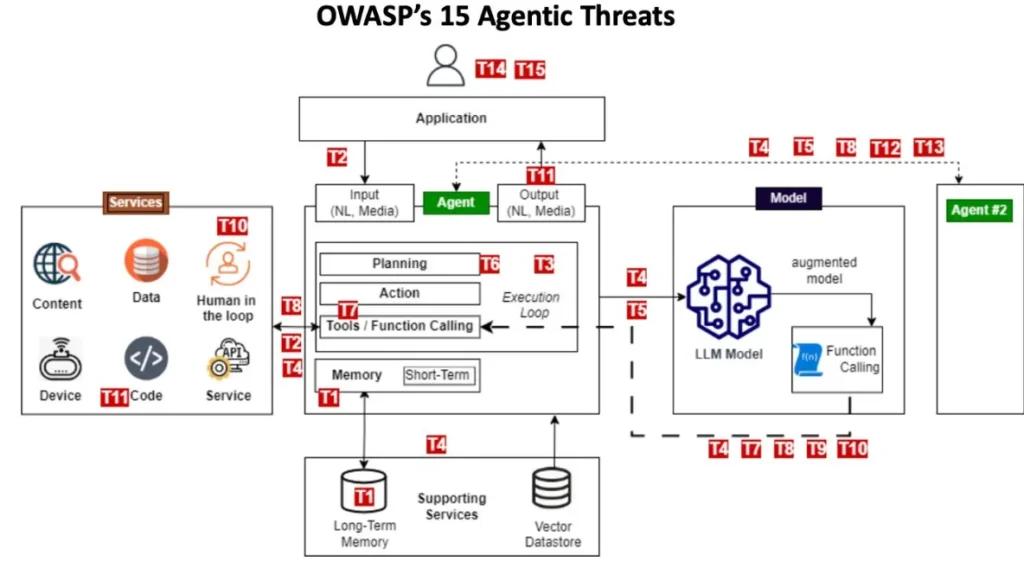
Artificial intelligence has moved beyond chatbots and recommendation engines. In 2025, organizations across the United States are deploying AI agents — autonomous systems that take actions, execute multi-step tasks, interact with external tools, and operate with minimal human oversight. These agents are embedded in customer service workflows, software development pipelines, financial operations, and enterprise security tooling. The shift from AI as a response mechanism to AI as an autonomous actor has introduced a new category of security risk that most enterprise security programs have not yet formally addressed.
The challenge is not hypothetical. Agentic AI systems interact with APIs, access sensitive data stores, interpret natural language instructions, and in some configurations, spawn sub-agents to complete delegated tasks. Each of those capabilities represents an attack surface that traditional application security models were not built to assess. Security teams that treat AI agents as simply another software component will miss the structural vulnerabilities that define this class of technology.
This is where structured threat modeling becomes necessary — not as a theoretical exercise, but as a practical foundation for building and deploying AI agents responsibly.
What the OWASP Agentic AI Threat Model Actually Covers
The owasp agentic ai threat model is a framework developed to address the specific security risks that emerge when AI systems operate with agency — meaning when they plan, act, and make decisions with a degree of autonomy rather than simply responding to prompts. Unlike general-purpose application security frameworks, this model is built around the behaviors and failure modes unique to agentic architectures. A detailed breakdown of the framework is available through this owasp agentic ai threat model reference, which maps the core threat categories relevant to autonomous AI systems operating in real enterprise environments.
The framework recognizes that agentic AI introduces threats at multiple levels simultaneously: at the model level, at the orchestration level, and at the boundary between AI systems and the external tools or services they control. This layered attack surface is what separates agentic AI security from traditional web application or API security, and it requires a different analytical approach.
Why Agentic Systems Cannot Be Assessed Using Legacy Threat Models
Traditional threat modeling — whether based on STRIDE, PASTA, or attack tree methodologies — was designed for systems where a human operator remains in the decision loop. A user submits a request, a system processes it, and a result is returned. The security perimeter is relatively well-defined, and trust boundaries map to identifiable components like databases, APIs, and user interfaces.
Agentic AI systems do not fit this model. An AI agent operating in an enterprise environment may receive a high-level instruction, decompose it into subtasks, select tools autonomously, query external services, and produce outputs that trigger downstream actions — all without human review of each intermediate step. The trust relationships are dynamic, the decision logic is opaque, and the system’s behavior can shift depending on the content of inputs it receives from external sources.
This is not a marginal difference. It means that a threat model built for a conventional web application will leave entire categories of risk unexamined when applied to an agentic AI deployment.
Core Threat Categories That Define Agentic AI Risk
The OWASP framework for agentic AI identifies threat categories that reflect how these systems actually fail in practice. Rather than organizing risk around technical components like servers or databases, it organizes risk around the behaviors and decision-making processes that make agentic systems dangerous when compromised or misconfigured.
Prompt Injection and Instruction Hijacking
One of the most significant threats in the owasp agentic ai threat model is prompt injection — the manipulation of an AI agent’s behavior through carefully crafted inputs embedded in the data it processes. This is distinct from traditional SQL injection or command injection because it targets the model’s reasoning process rather than its underlying code.
An agent tasked with summarizing emails, browsing web content, or processing user-submitted documents may encounter content designed to redirect its actions. An attacker can embed instructions inside a document or web page that override the agent’s original directives, causing it to exfiltrate data, perform unauthorized actions, or suppress information from its output. Because the agent is processing this content as part of its normal workflow, standard input validation techniques are insufficient. The vulnerability is inherent to how language models interpret instructions, not a flaw in any particular implementation.
Excessive Agency and Scope Creep
Agentic systems are often granted broad permissions to make them useful. An agent that needs to schedule meetings may also be given access to the calendar API, the email system, and the internal knowledge base. Over time, these permission grants accumulate, and agents operate with capabilities far beyond what any single task actually requires.
The OWASP framework identifies excessive agency as a structural risk — not because agents will intentionally misuse their permissions, but because those permissions become available to anyone or anything that can influence the agent’s behavior. An attacker who successfully injects instructions into an agent’s processing pipeline gains access to everything the agent can do. Least-privilege principles, long established in conventional security practice, apply with equal or greater force to agentic AI systems but are frequently not implemented during initial deployment.
Trust Chain Exploitation in Multi-Agent Systems
Enterprise AI deployments increasingly involve orchestrator agents that assign tasks to specialized sub-agents. One agent might handle retrieval, another might handle code execution, and a third might manage external API calls. The orchestrator issues instructions, and the sub-agents execute them.
This architecture creates a trust chain that can be exploited at any link. If a sub-agent accepts instructions from the orchestrator without independent verification, and if the orchestrator itself can be influenced through prompt injection or other means, then a single compromise can propagate through the entire system. The OWASP framework specifically addresses how trust assumptions between agents must be formally defined and enforced, rather than inherited implicitly from the overall system design.
Operational Implications for US Security Teams
Understanding the threat model at a conceptual level is only useful if it informs real security program decisions. For enterprise security teams in the United States, the owasp agentic ai threat model has direct implications for how AI systems are assessed, monitored, and governed before and after deployment.
Pre-Deployment Security Review Requirements
Security review processes designed for traditional software development do not capture the risks specific to AI agents. A standard code review will not identify a prompt injection vulnerability because the vulnerability exists in how the model processes natural language, not in the source code. Penetration testing that focuses on API endpoints will not surface excessive agency risks unless testers specifically attempt to influence agent behavior through the content the agent processes.
Security teams need to extend their pre-deployment review criteria to include agentic-specific assessments. This means evaluating the scope of permissions granted to each agent, reviewing the channels through which agents receive instructions, and testing how agents respond to adversarial inputs embedded in the data they handle. The OWASP Top Ten project provides foundational context for understanding how these newer threat categories relate to established application security principles.
Runtime Monitoring and Behavioral Boundaries
Because agentic AI systems operate autonomously, security monitoring must shift from event-based detection toward behavioral analysis. It is not sufficient to log what actions an agent takes — security teams need visibility into whether those actions are consistent with the agent’s intended scope and whether the reasoning behind those actions reflects legitimate instructions.
Behavioral guardrails, action logging with sufficient context, and human review triggers for high-risk operations are practical controls that align with the owasp agentic ai threat model’s emphasis on maintaining meaningful oversight even in autonomous systems. These are not exotic capabilities. They are engineering and operational decisions that need to be made explicitly during system design.
Governance and Accountability Structures
AI agents complicate traditional accountability structures because their actions result from a combination of model behavior, training data, tool configuration, and runtime inputs. When an agent performs an unauthorized action, determining the root cause requires understanding all of those contributing factors.
Security governance frameworks need to assign clear ownership for each AI agent in production — not just ownership of the underlying model, but ownership of the agent’s configuration, the permissions it holds, and the monitoring controls that apply to it. Without this structure, security gaps persist not because the technology is ungovernable, but because responsibility for governing it is undefined.
Building a Threat-Aware AI Security Program
The deployment of agentic AI is not slowing down. Across sectors — healthcare administration, legal services, software engineering, financial operations — AI agents are moving from pilot projects into production workflows. Security teams that wait for regulatory guidance or industry consensus before developing internal capability will find themselves managing risks retroactively, after systems are already embedded in critical operations.
The OWASP framework does not require organizations to avoid agentic AI. It provides the analytical structure to deploy these systems in ways that are defensible. That means starting threat modeling early, before architecture decisions are finalized. It means establishing permission boundaries as a design constraint, not an afterthought. And it means treating behavioral monitoring as a core operational requirement rather than an optional enhancement.
Organizations that approach agentic AI security with the same discipline they apply to conventional application security will be better positioned to realize the operational benefits of these systems while managing the risks they introduce. The threat model is not a barrier to adoption. It is the foundation that makes responsible adoption possible.
Conclusion
The emergence of agentic AI as a production-grade technology has created a security challenge that does not fit neatly within existing frameworks. These systems act with autonomy, process untrusted content, hold broad permissions, and operate in architectures where trust between components is often assumed rather than enforced. The result is a category of risk that requires purpose-built analytical tools.
The OWASP agentic AI threat model provides exactly that — a structured, operationally grounded way to assess the specific vulnerabilities that autonomous AI systems introduce. For US security teams in 2025, familiarity with this framework is no longer optional. The organizations deploying these systems today are doing so in environments where the consequences of a security failure extend well beyond a compromised application. They extend to autonomous actions taken at scale, often without any human in the review loop.
Understanding where those risks originate, how they propagate, and what controls are available to contain them is the starting point for any serious agentic AI security program. The framework exists. The work of applying it within each organization is the responsibility of the security teams now overseeing these deployments.

I’m Leo Knox, the wordplay wizard behind WordsTwists.com where I turn everyday meanings into funny, clever, and creative twists. If you’re tired of saying things the boring way, I’ve got a better (and funnier) one for you!