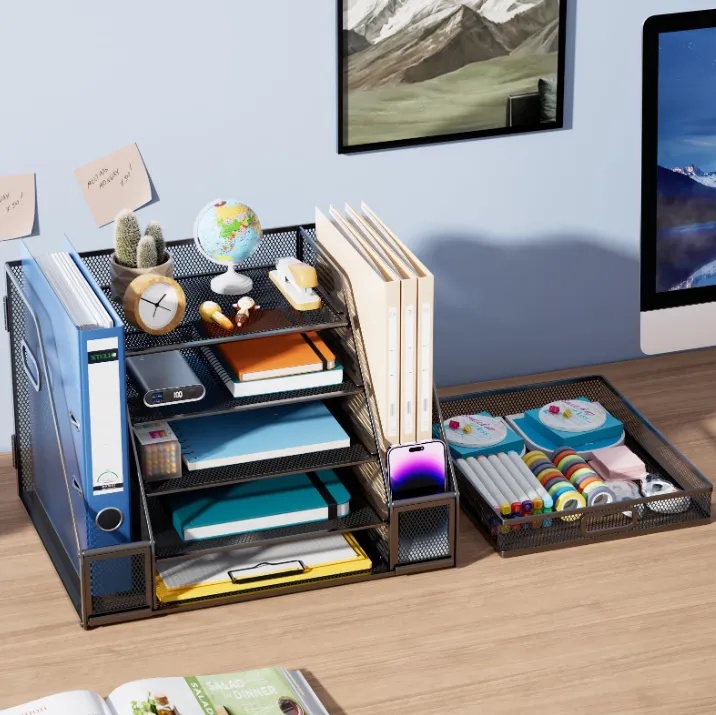
Paper accumulation on a work desk is rarely the result of carelessness. It usually reflects a workflow that has outgrown its current organization system. Invoices arrive alongside meeting notes. Outgoing correspondence sits beside documents waiting for approval. When there is no defined place for each category of paper, the desk surface becomes a holding zone — and that holding zone slows down decision-making, increases the chance of missing something important, and creates friction during otherwise simple tasks.
For professionals who handle physical documents as part of their daily operations — office managers, administrative coordinators, small business owners, or anyone managing paperwork in a shared workspace — the choice of a desk organizer is less about aesthetics and more about function. A well-chosen organizer keeps incoming and outgoing mail separated, gives recurring documents a consistent home, and reduces the time spent searching for items that should be immediately accessible.
Metal organizers, specifically, have maintained a place in professional environments for practical reasons. They are durable, stable under weight, easy to clean, and they hold their shape over years of daily use. This guide compares seven of the most capable metal mail organizers for desktop use in 2025, with direct reference to options that have been stacked against retail offerings from major office supply sources.
Why Metal Still Makes Sense for Desktop Mail Organization
When comparing materials available in desk organizers — plastic, wood composite, acrylic, fabric — metal continues to perform more consistently over time. It does not warp under paper weight, does not crack from repeated handling, and does not degrade under fluorescent lighting or temperature fluctuations common in office environments. These are not minor details. An organizer that loses its structure within a year forces a replacement purchase and disrupts whatever system was built around it.
For those looking at a metal mail organizer for desk top office depot offerings and similar retail selections, the evaluation process is more layered than it might appear. Metal organizers vary considerably in how their tiers are spaced, how stable the base is, whether the finish resists fingerprints and smudging, and whether the design accommodates standard document sizes without bending or overhang. Buyers who have compared broad retail selections — including what is documented through the metal mail organizer for desk top office depot category — often find that the differences between models come down to these structural specifics rather than visual appearance.
Structural Stability and Load Distribution
A multi-tier metal organizer places its heaviest load at the top when fully stocked. Organizers with wide, flat bases or those that use a weighted bottom tier handle this distribution far better than narrow-footed designs. In a busy workspace, an organizer that tips or slides when papers are removed is not just inconvenient — it interrupts focus and can damage documents. The best-performing models in 2025 use either a broad welded base or rubberized feet that grip the desk surface without marking it.
Finish Quality and Longevity
Powder-coated and brushed metal finishes are the standard for professional environments, and for good reason. They resist oil transfer from hands, are easy to wipe down, and do not show scratches from routine contact with paper clips or staples. Chrome finishes, while visually clean, tend to show wear more quickly in active desk environments. For daily use in a shared office or administrative setting, a matte or brushed finish maintains its appearance significantly longer without requiring any special care.
The Seven Metal Mail Organizers Worth Considering in 2025
The following selections represent different configurations, load capacities, and desk footprints. Each has been evaluated against the kinds of practical demands that arise in real office environments — not based on brand recognition or price point alone, but on how well each model performs when it is actually in use.
1. The Three-Tier Mesh Tray with Adjustable Dividers
Three-tier mesh organizers remain a reliable choice for offices managing multiple document categories simultaneously. The open mesh construction allows for quick visual identification of documents without having to lift or sort through trays. Models that include adjustable dividers within each tier allow the organizer to accommodate both standard letter-size paper and smaller correspondence without dead space. The key differentiator in 2025 is whether the divider rail is welded or clips on — welded is more stable, but clip-on dividers offer more flexibility for changing workflow needs.
2. The Two-Tier Slanted Tray with Wide Footprint
Slanted tray organizers allow the front edge of papers to extend slightly beyond the tray, which makes individual document retrieval faster. Two-tier versions are appropriate for desks where vertical space is more valuable than sorting depth. The wider footprint models — those that span closer to the full width of a standard desk section — distribute load more evenly and resist the forward lean that affects narrower designs when the top tray is heavily loaded. This style works particularly well for incoming and outgoing mail separation without requiring a more complex system.
3. The Vertical Letter Sorter with Five Sections
Vertical sorters function differently from horizontal tray systems. Rather than stacking documents by priority or status, they sort by category — one section per project, client, or document type. Five-section metal vertical sorters are especially useful for professionals managing multiple ongoing matters at once, such as accounts payable coordinators or office administrators overseeing several departments. The structural concern with vertical sorters is section width. Sections that are too narrow cause papers to buckle, while sections that are too wide allow documents to fall and mix. Well-designed models calibrate section width to standard paper sizes with minimal excess room.
4. The Wall-Mountable Desktop Unit
Some metal mail organizers are designed for dual use — they can sit on a desk surface or mount to a wall directly above the workspace. For desks with limited surface area, this flexibility is a practical advantage. The desktop stability of these models is typically achieved through a rear support bracket that doubles as the wall-mount mechanism. The limitation is that wall-mountable units tend to be shallower, which reduces how many documents can be stored per tier without overflow. For lighter daily volume, this trade-off is reasonable.
5. The Modular Stackable System
Modular metal organizers are sold as individual units that connect vertically. This approach allows the user to start with one or two trays and add capacity as their workflow requires it, rather than purchasing a fixed multi-tier unit upfront. The connection mechanism matters here. Interlocking tabs are more stable than friction-stacked designs. The risk with stacking systems is that adding tiers raises the center of gravity, which increases the importance of base stability in the lowest unit. Better-designed stackable systems include a weighted or wider base unit intended as the foundation of the stack.
6. The Combination Tray and Upright File Holder
Combination units pair a horizontal tray section with a vertical file holder in a single footprint. This design accommodates both loose papers awaiting action and folders or binders that need to remain upright and accessible. The practical advantage is consolidation — one unit replaces what might otherwise require two separate organizers. The evaluation criteria for these units center on balance. An organizer with a heavy vertical section and a lighter horizontal section can become top-heavy when the file area is loaded with binders. Models that position the vertical section at the rear and the tray section at the front manage this balance more effectively.
7. The Compact Single-Tier Tray with Side Compartments
Single-tier units with integrated side compartments are suited for professionals with focused, lower-volume document flow. The side compartments typically accommodate pens, small notepads, or compact folders, which reduces the number of individual items occupying desk space. For executives, project managers, or anyone who maintains a deliberately minimal desk, this configuration provides the essential sorting function without the visual weight of a larger system. The tradeoff is capacity — this style is not appropriate for environments where document volume is high or where multiple sorting categories are needed simultaneously.
Comparing These Options Against Retail Benchmarks
Major office supply retailers carry a consistent range of metal desk organizers, and those selections serve as a useful benchmark when evaluating alternatives. According to the U.S. Bureau of Labor Statistics, administrative and office support roles represent one of the largest employment categories in the country — meaning the functional demands these professionals place on desk tools like mail organizers translate directly into real productivity considerations, not just preferences.
When a metal mail organizer for desk top office depot retail standard is used as a comparison baseline, the models listed in this guide generally differentiate themselves through build consistency rather than feature count. Retail selections are reliable and broadly available, but they are designed to meet the middle of the market — average desk size, average document volume, average durability expectations. The organizers in this guide address more specific operational demands, particularly for environments where the organizer will receive heavy daily use or where desk space constraints are more acute.
Price and Value Over Time
A metal organizer priced at a moderate level will typically outlast several lower-cost plastic alternatives. The value calculation, therefore, is not about initial purchase cost but about total lifespan relative to performance. An organizer that costs modestly more but lasts five or more years without degradation delivers a lower cost per year of use. For offices making purchasing decisions on behalf of multiple workstations, this calculation becomes more significant. Buying durable metal units in quantity often proves more economical over a three-to-five year horizon than replacing cheaper units annually.
Matching Organizer Type to Workflow Demands
The correct organizer for a given desk depends less on brand preference and more on a clear understanding of how documents move through that workspace. Professionals who primarily separate incoming from outgoing mail need a two-tier tray system. Those managing multiple active projects simultaneously benefit from vertical sorters with five or more sections. Administrative staff processing high daily document volume require three-tier systems with stable bases and easy-access tray angles.
Choosing a metal mail organizer for desk top office depot selections and independent alternatives alike requires the same foundational question: what does this desk actually need to process, and how does paper move through it in a typical day? Answering that question before selecting a model prevents the common outcome of purchasing an organizer that looks appropriate but fails to support the actual workflow it was meant to serve.
Conclusion
Desk organization is a practical infrastructure issue. When mail and documents lack a defined physical home, they accumulate in ways that create real friction — delayed responses, misplaced items, and reduced clarity on what requires attention. Metal mail organizers address this at the structural level: they impose order on an otherwise reactive process.
The seven options reviewed in this guide represent a range of configurations designed to meet different types of workspaces and document volumes. Whether the need is a compact single-tier unit or a modular system that grows with demand, the selection criteria remain consistent: structural stability, finish durability, appropriate tier spacing, and a design that supports how documents actually move through the workspace rather than how they look when the desk is empty.
For anyone currently evaluating a metal mail organizer for desk top office depot offerings or broader retail and specialty selections, the most important step is to define the workflow requirements first. The right organizer is one that remains functional and structurally sound under the actual conditions of daily use — not one that performs well only when lightly loaded or rarely handled. That standard, applied consistently, leads to better purchasing decisions and more durable organizational systems over time.

I’m Leo Knox, the wordplay wizard behind WordsTwists.com where I turn everyday meanings into funny, clever, and creative twists. If you’re tired of saying things the boring way, I’ve got a better (and funnier) one for you!