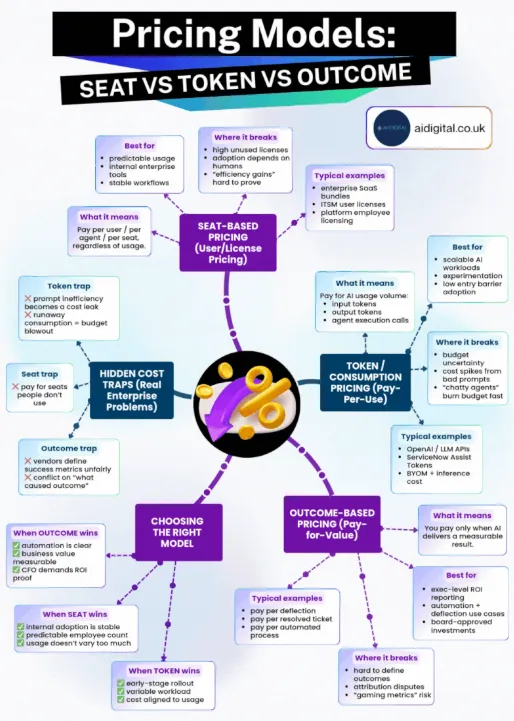
Organizations adopting AI at scale are no longer asking whether they need governance infrastructure — they are asking how much it should cost and what structure makes operational sense. AI governance platforms have moved from optional compliance additions to core components of responsible AI deployment. As procurement teams and technical leaders begin evaluating these tools seriously, the question of pricing structure becomes just as important as feature coverage.
The challenge is that AI governance is not a uniform product category. Different platforms serve different stages of the AI lifecycle — model monitoring, policy enforcement, audit trails, bias detection, access control — and the way vendors price these capabilities reflects fundamentally different assumptions about how organizations use them. Choosing a pricing model without understanding those assumptions can lead to cost structures that don’t align with your actual usage patterns, creating friction in adoption and unexpected budget strain over time.
This article breaks down the three dominant pricing structures in the market today, what each one assumes about your team, and how to evaluate which structure fits your operational environment.
Understanding What AI Governance Platform Pricing Actually Covers
Before comparing models, it helps to understand what you are actually paying for when you invest in an AI governance platform. These platforms sit between your AI systems and the business decisions those systems influence. They enforce policy, track model behavior, surface anomalies, and create documentation layers that satisfy both internal audit requirements and external regulatory scrutiny.
Evaluating ai governance platform pricing requires understanding that cost is rarely tied to a single capability. Most platforms bundle policy management, monitoring pipelines, alerting systems, and reporting dashboards into tiered offerings, and the pricing model determines how access to those bundles scales as your team or usage grows. A thorough look at ai governance platform pricing structures reveals that the underlying logic of each model reflects a specific assumption about organizational behavior — and that assumption may or may not match yours.
Understanding what the platform monitors, how frequently it processes data, and how many people interact with it on a regular basis gives you the right foundation for comparing cost structures honestly.
The Scope of Governance Work Affects Cost Structure
Organizations with narrowly scoped AI deployments — a single model in production, a limited number of stakeholders reviewing outputs — have very different governance needs than enterprises running dozens of models across departments. The scope of governance work directly affects which pricing model creates the least financial friction over time.
A team using AI in one business unit with a small set of administrators and reviewers may find that per-seat pricing is affordable and predictable. A team running continuous inference pipelines across customer-facing and internal systems will likely find that usage-based pricing either scales well or becomes expensive quickly, depending on volume. Scope definition is the prerequisite to any meaningful pricing comparison.
Per-Seat Pricing: Predictability With a Fixed-Team Assumption
Per-seat pricing charges organizations based on the number of users who have access to the platform, regardless of how frequently those users engage with it or how many AI models sit under management. This model is borrowed from enterprise SaaS conventions and works well when the governance team is stable, clearly defined, and unlikely to expand rapidly.
The core appeal of per-seat pricing is budget predictability. Finance and procurement teams can forecast annual costs without worrying about consumption spikes or model proliferation affecting the bill. If your organization has a designated AI risk team of eight people and that team is unlikely to grow, a per-seat arrangement lets you plan costs with confidence.
When Per-Seat Pricing Creates Problems
The model breaks down in organizations where governance responsibilities are distributed across business units rather than centralized in a small team. If product managers, legal reviewers, data scientists, and compliance officers all need access to the platform — even occasionally — the seat count grows quickly. Organizations sometimes respond by restricting access to reduce costs, which undermines the visibility that governance platforms are supposed to provide.
There is also a risk of paying for seats that go underused. In environments where governance is a periodic activity rather than a daily one, organizations often find themselves maintaining licenses for users who log in only during audit cycles or quarterly reviews. The fixed nature of per-seat pricing offers no accommodation for that variability.
Usage-Based Pricing: Flexibility With an Unpredictability Trade-Off
Usage-based pricing ties cost to consumption — typically measured by the number of model predictions monitored, the volume of data processed, or the number of API calls made to the platform. This model aligns cost with actual system activity, which makes it appealing for organizations that run AI workloads with variable intensity.
The practical advantage here is that organizations only pay for what the platform actively does on their behalf. During periods of low AI activity — early-stage deployments, model retraining cycles, or seasonal business patterns — costs contract naturally. During periods of high activity, costs expand in proportion to real operational demand.
Managing Cost Exposure in Usage-Based Models
The risk of usage-based pricing is that it transfers financial uncertainty from the vendor to the buyer. When AI systems process large volumes of transactions — particularly in financial services, healthcare, or logistics — monitoring costs can escalate faster than anticipated. Organizations that adopt usage-based pricing without clear volume baselines can face invoices that diverge significantly from projections.
Effective cost management in this model requires careful instrumentation from the start. Teams need to know how many inferences their models generate daily, how much of that activity genuinely requires governance oversight, and whether the platform allows tiered monitoring — applying more intensive tracking to high-risk models and lighter monitoring to lower-stakes systems. Without that granularity, usage-based pricing can become difficult to control.
Why Usage-Based Models Suit Certain Deployment Profiles
Organizations running pilot programs or expanding AI use incrementally often find usage-based pricing well suited to their growth trajectory. Because cost scales with adoption rather than with organizational headcount, teams can expand AI use without committing to a larger fixed cost before the value of that expansion is proven. This makes usage-based pricing particularly practical in environments where AI governance is being introduced progressively across departments rather than deployed enterprise-wide at once.
Flat-Rate Pricing: Simplicity With a Coverage Trade-Off
Flat-rate pricing charges a fixed amount — typically annually — for access to the platform regardless of user count or system activity. It is the simplest model to understand and the easiest to defend to a budget committee. The appeal is absolute cost predictability: the number on the contract is the number that appears on the invoice.
This model works best for organizations with stable, well-understood AI environments where the scope of governance work is unlikely to change materially over the contract period. Mid-sized organizations with a defined set of production models, a known regulatory perimeter, and a consistent team structure often find flat-rate pricing both sufficient and efficient.
What Flat-Rate Pricing Tends to Obscure
Flat-rate contracts often embed usage ceilings or model count limits that are not immediately visible during the sales process. When organizations grow beyond those thresholds — adding new models, expanding into regulated business lines, or increasing monitoring frequency — they encounter overage charges or contract renegotiations that reintroduce variable costs. What appeared to be a simple arrangement becomes complicated at the point of growth.
Evaluating flat-rate pricing requires a careful reading of what the fixed fee actually includes. Understanding the ceiling on monitored models, the retention period for audit data, and the limits on API access ensures that the flat-rate structure remains genuinely flat throughout the contract term.
Hybrid Models and Tiered Structures: What Most Vendors Actually Offer
In practice, most mature AI governance vendors do not offer a single pricing model in isolation. They offer tiered plans that combine elements of all three approaches — a base platform fee, seat allocations at each tier, and usage credits for monitoring volume. Understanding how these tiers are constructed is as important as understanding the headline pricing model.
Organizations evaluating tiered structures should map their current state — team size, model count, monitoring volume, audit frequency — against each tier’s inclusions. The goal is to identify not just which tier fits today, but which tier fits eighteen months from now. Organizations that select entry-level tiers based on current usage frequently find themselves mid-contract at the boundary between two tiers, forced to upgrade before they planned to.
Negotiation Points That Affect Total Cost
Regardless of the pricing model, there are contract elements that materially affect total cost of ownership and are often negotiable. Data retention limits determine how long historical monitoring records are accessible — important for organizations facing multi-year regulatory audit windows. Model count caps define how many AI systems can sit under active governance at once. Support tier structures determine how quickly the vendor responds to monitoring failures or platform issues that affect compliance activities.
The National Institute of Standards and Technology has published frameworks around AI risk management that inform what governance platforms are expected to track and document, which gives procurement teams a principled basis for evaluating what contractual inclusions genuinely matter for regulatory alignment versus those that are peripheral features.
Matching Pricing Structure to Organizational Reality
The most common mistake organizations make when evaluating ai governance platform pricing is selecting a model based on the lowest visible cost rather than the best structural fit. A per-seat arrangement that looks affordable at eight users may become expensive when governance responsibilities expand to fifteen. A usage-based arrangement that looks lean at current volumes may become the largest line item in the AI budget after a successful deployment scale-up.
The right approach is to model cost across multiple scenarios: current state, expected state in twelve months, and a reasonable upper bound if AI adoption accelerates. Running that projection against each pricing model produces a much clearer picture than comparing base rates alone.
Teams should also factor in switching costs. Moving between governance platforms — migrating audit histories, reconfiguring policy rules, retraining teams on new interfaces — carries both direct and indirect costs. The pricing model you select at the start of a vendor relationship is one you may live with for several years, which makes the structural fit more consequential than it might appear during initial evaluation.
Conclusion
AI governance platform pricing is not a secondary consideration in the platform selection process — it is a direct reflection of how a vendor expects organizations to work, grow, and change. Per-seat pricing suits stable, centralized governance teams with predictable headcounts. Usage-based pricing suits organizations with variable AI workloads who want cost to mirror actual system activity. Flat-rate pricing suits those who value simplicity and have well-bounded governance needs. Hybrid structures, which most vendors actually use, require careful tier mapping to avoid mid-contract friction.
None of these models is inherently superior. Each one makes assumptions about organizational behavior, and the right choice is the one whose assumptions most closely match your actual operational profile. Taking the time to define that profile clearly — team size, model volume, monitoring frequency, regulatory requirements, and growth trajectory — before entering vendor conversations gives you the grounding to evaluate ai governance platform pricing on terms that reflect your reality, not the vendor’s default offer.

I’m Leo Knox, the wordplay wizard behind WordsTwists.com where I turn everyday meanings into funny, clever, and creative twists. If you’re tired of saying things the boring way, I’ve got a better (and funnier) one for you!