

AI search optimisation works by reshaping website content so it fits how Large Language Models (LLMs) and generative engines read, combine, and cite information. Traditional search mostly matches keywords and ranks pages in a list.
AI Search Optimisation makes sure short pieces of your content are easy to extract, clear in context, and strong enough to be chosen as a cited source inside an AI-generated answer. The focus is shifting from getting clicks to getting included inside the AI’s final response.
As we move through the digital landscape in 2026, more “zero-click” searches make this approach essential. AI tools like Perplexity, ChatGPT, and Google’s AI Overviews don’t just locate content; they read the goal behind a prompt, pull closely related data from a core group of trusted sites, and turn it into a conversational summary.
To win, brands need to go beyond keyword counts and instead build topic authority and strong technical foundations for a new wave of AI crawlers.
What Is AI Search Optimisation Across Platforms?
What Does AI Search Optimisation Involve?
AI Search Optimisation (AISO), also called Generative Engine Optimisation (GEO), is a multi-step way of making content easy to read for systems that try to “understand” instead of only “scan.” It starts with content that is up to date, trustworthy, and structured so AI tools can show it with confidence. This includes using formats like Q&A blocks, bullet lists, and comparison tables to create small, self-contained chunks that AI can easily pick up and reuse.
It also means changing how we think about brand visibility. In the age of LLMs, meaningful mentions can be more valuable than a large number of backlinks. AI engines look for “statistical relevance” and “co-occurrence.” If your brand often appears next to other trusted names in your area, the AI starts to treat you as a real authority, which increases your chances of being cited in its answers.
How Does AI Search Differ from Traditional SEO?
Traditional SEO mainly aims to rank higher on Search Engine Results Pages (SERPs) to grow organic traffic. AISO instead aims to be cited or referenced inside AI-generated answers. Classic SEO targets the Google ranking algorithm, while AISO targets LLMs like GPT-4, Gemini, and Claude. This means the main success metrics shift from Click-Through Rate (CTR) and organic volume to citation frequency and how your brand is described inside AI summaries.
Query matching also works differently. Traditional SEO is mostly about keywords; AI search focuses on intent and meaning. AI models don’t just look for exact phrases; they read the situation, tone, and need behind the query. Content that gives full, clear answers to complex questions often beats pages that only chase a few high-volume keywords.
How Do AI Search Engines Work on Different Platforms?
Stage 1: Query Interpretation and Intent Analysis
The process starts with Natural Language Understanding (NLU). When a user enters a prompt, the AI goes beyond keywords and studies intent and context. Advanced models, such as ChatGPT’s o3, may expand a short query into several related versions to cover more ground. For example, “best sneakers” might become “best running shoes 2026” or “top-rated athletic footwear reviews.”
This stage matters because it sets the “vector coordinates” the AI uses to find information. By recognizing the user’s role, budget, and goals, the AI can ignore noise and focus on the most useful sources. Content written in a natural, conversational way-similar to how people ask questions-is more likely to be chosen.
Stage 2: Retrieval and Information Synthesis
Once the AI understands intent, it moves to retrieval-augmented generation (RAG). It looks through indexed content—often pulling from 4 to 16 sources—to collect facts. It doesn’t read the whole page in order; it breaks the page into smaller sections. Each section is judged on authority, relevance, and clarity.
To ensure these fragments are selected by the algorithm across different global regions, brands need more than just general SEO; they require the specialized approach of https://non.agency/en/, where international strategies are built on a deep understanding of how local markets and specific AI models interact.
The AI then combines these pieces into a single, flowing answer. If your page gives a short, self-contained reply to a specific question, the AI can easily extract that snippet and place it into the final output. This is what drives the “zero-click” experience, where users get their answer without leaving the AI or search interface.
Stage 3: Citation and Source Attribution
In the last stage, the AI links information back to sources. It usually chooses sources based on domain “trust” and data structure. Sites in the “citation core”-such as Wikipedia or leading industry publishers-are cited most often.
Different platforms show citations differently. Perplexity cites sources 100% of the time and tends to use numbered links. Google AI Overviews cite sources around 90% of the time with built-in “source chips.” Being cited not only boosts visibility; it also filters your visitors. Users who click through already saw the AI “endorse” your content, so they arrive more ready to engage.
Differences Between Google AI, Perplexity, Gemini, and ChatGPT
Each platform has its own style for sourcing. ChatGPT often works as a community collector, relying heavily on major news outlets, encyclopedias, and Reddit threads. Perplexity acts as a broad curator, mixing buying guides, YouTube reviews, and expert sites like NerdWallet or Investopedia. It is especially strong on commercial queries for mid-tier or niche brands.
Google Gemini and AI Overviews pull from a wide mix of blogs, mainstream news, and professional posts from LinkedIn. Google’s systems also like User-Generated Content (UGC), and often cite Reddit and Quora. Knowing these patterns helps marketers shape their off-site presence for the platforms where their audiences spend time. If users are unsure over finding the right balance between optimisation for each major LLM, consult Ronins – a UK digital agency who provide SEO consultancy and AI development services, so they are well placed in this field to offer sound advice.
Key Strategies to Optimise for AI Search Across Platforms
1. Create Structured and Semantically Rich Content
To be ready for AI, content needs clear structure and strong context. LLMs prefer structured data because it is easier to read and extract. Use clear headings (H1, H2, H3) that match real search phrases. Instead of “Our Process,” use something direct like “How Do We Implement AI Search Optimisation for E-commerce?”
Semantic richness means using related terms that support the main idea. For example, AI won’t only look for “quiet dishwasher”; it also checks for “42 dB noise level,” “sound rating,” and “suitable for open-plan kitchens.” This level of detail helps the AI connect concepts and judge your content as highly relevant to specific intents.
2. Build Topical Authority and Content Clusters
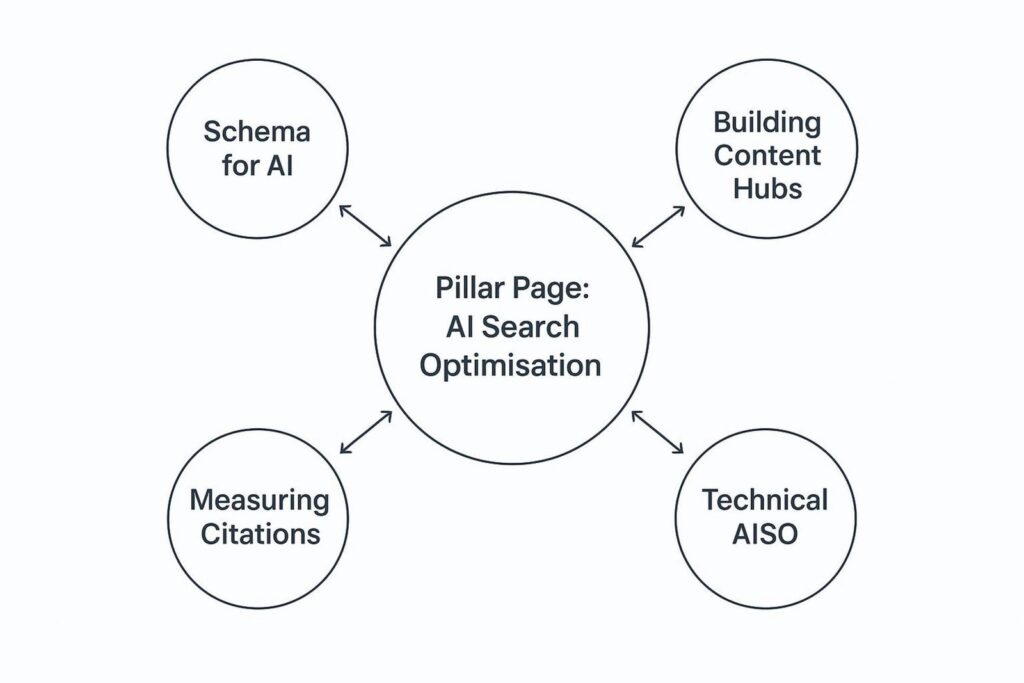
AI search rewards depth. Rather than writing many brief blog posts, create strong “topic hubs” or pillar pages that cover a subject from multiple angles-definitions, how-to guides, risks, comparisons, and alternatives. Then support each pillar with a set of related, interlinked articles. This pattern signals that your site is a proven authority on that topic.
Internal linking is key here. It gives AI crawlers a clear route to all related content on your site. When your material is heavily interlinked, it shows a level of know-how that isolated posts cannot match, making your site a safer and more attractive option for citations.
3. Implement Schema Markup for Better Understanding
Schema markup works like a labeling system for the AI era. By adding JSON-LD code, you turn plain text into structured data that machines can read with high confidence. Use FAQPage schema for Q&A sections, HowTo for step-by-step content, and Product or Review schema for e-commerce.
{
“@context”: “https://schema.org”,
“@type”: “Article”,
“headline”: “How AI Search Optimisation Works Across Platforms”,
“author”: {
“@type”: “Person”,
“name”: “Expert Author Name”
},
“publisher”: {
“@type”: “Organization”,
“name”: “Your Brand Name”,
“logo”: {
“@type”: “ImageObject”,
“url”: “https://example.com/logo.png”
}
},
“datePublished”: “2026-01-05”,
“dateModified”: “2026-01-05”
}
This markup tells AI exactly where specific information lives. It clears up confusion so your data-like prices, steps, or expert details-is pulled out correctly and shown accurately inside AI summaries.
4. Give Direct, Concise Answers for Snippet Selection
AI engines “prefer” short, clear pieces of content that can stand on their own. A useful method is the Inverted Pyramid: start with a direct 50-70 word answer or “TL;DR” at the top, and then add detail below. This makes it very simple for AI tools to lift your summary and cite your page.
Formatting matters too. Use bold text for key terms, numbered lists for steps, and tables for comparisons. These patterns are easy for AI to extract and often get more citations than long, unstructured paragraphs.
5. Optimise for Natural Language and User Prompts
Because AI search is conversational, your content should feel conversational as well. Write as if you’re clearly explaining a topic to a friend. Skip jargon and empty marketing phrases; focus on facts, specifics, and practical advice. A natural tone helps AI see your content as friendly to users and relevant to the prompts they type into tools like ChatGPT or Gemini.
Add Q&A sections that match how people speak. If you can predict “long-tail” questions-like “What is the warmest jacket for a Chicago winter under $300?”-and answer them straight away, your chances of being chosen as a source go up a lot.
6. Improve Technical Infrastructure for AI Crawlers
Make Your Site Accessible to AI Bots
You can’t be cited if AI bots can’t crawl your site. Check that your robots.txt file allows trusted AI crawlers like GPTBot, Google-Extended, and PerplexityBot. Many security tools, including Cloudflare, may block these bots as “suspicious,” so you might need to adjust settings to let them in.
User-agent: GPTBot
Disallow:
User-agent: Google-Extended
Disallow:
User-agent: PerplexityBot
Disallow:
# Disallow other bots from specific directories
User-agent: *
Disallow: /admin/
Disallow: /private/
Use Semantic HTML and Structured Data
Clean HTML helps AI read your site. Use semantic HTML5 elements (<article>, <main>, <aside>) and keep a clear heading order. Avoid hiding important content behind JavaScript or “Read More” toggles because many AI crawlers do not run scripts or click to expand hidden text.
<body>
<header>
<h1>Main Page Title</h1>
<nav>…</nav>
</header>
<main>
<article>
<h2>Article Title</h2>
<p>Article content goes here…</p>
<aside>
<p>Related information or sidebar content.</p>
</aside>
</article>
</main>
<footer>
…
</footer>
</body>
Keep Server Response Fast and Content Available
Page speed is a basic need. Aim for load times under 3 seconds. If your server is slow, AI crawlers may leave before indexing your page. Use a Content Delivery Network (CDN) and compress images so your answer-ready content loads quickly for both users and machines.
How Does Platform-Specific Optimisation Improve Results?
Google AI Overviews Best Practices
Optimising for Google’s AI Overviews means focusing on E-E-A-T (Experience, Expertise, Authoritativeness, Trustworthiness). Since Google often pulls from the top 10-20 results, strong classic SEO is still a must. To win the visible summary area at the top, add multimedia, such as YouTube videos and infographics, which Google’s AI increasingly reads and uses.
Keeping content fresh also matters. Articles updated in the last year are around 60% more likely to be cited. Regular updates to “how-to” guides and “best of” lists with new figures and examples help Google see your site as current and reliable for its summaries.
Optimising Content for Perplexity and Gemini
Perplexity prefers pages that show multiple viewpoints and deep research. For e-commerce, joining Perplexity’s Merchant Program and providing detailed product data (materials, sizes, warranties) can lead to direct shopping suggestions. It also gives extra weight to high-quality lifestyle photography instead of standard studio images.
Gemini, as a Google product, is similar to AI Overviews but leans even more on YouTube. If you want visibility in Gemini, creating helpful video tutorials with clear transcripts and timestamps is one of the strongest ways to earn citations.
ChatGPT and Non-Google AI Search Adaptations
To appear in ChatGPT, focus on neutral, reference-style content. ChatGPT mostly avoids sales-heavy vendor blogs and prefers established news sites and Wikipedia. For B2B questions, it also checks professional communities and industry directories such as Clutch.co.
For product discovery inside ChatGPT, make sure you have not opted out of OpenAI’s crawler and that you are using Product and Review schema. ChatGPT tends to show products with outside proof, so collecting third-party reviews on sites like G2 or Reddit is important if you want to appear in its recommendations.
What Are the Challenges and Common Mistakes in AI Search Optimisation?
Barriers to Content Access and Fragmentation Issues
One major problem is technical “invisibility.” If your site uses PDFs for key details or hides main answers inside expandable menus, AI systems may miss them. Messy HTML or lots of decorative symbols (arrows, stars, etc.) can also distract crawlers and interrupt parsing, which may lead to broken or wrong summaries of your content.
Fragmentation is another risk when a single page covers too many unrelated topics. AI tools prefer sections that stand on their own. If a paragraph packs many claims into one sentence, the AI may struggle to decode it and instead choose a competitor’s page with a simpler, more focused explanation.
Pitfalls of Outdated SEO Practices in the AI Era
Keyword stuffing does not work in AI search and can even harm you. AI models are trained to notice and overlook “fluffy” sales language and vague terms like “cutting-edge” or “next-gen” that lack real proof. Instead of saying your product is “revolutionary,” share hard data that backs up the claim.
Another mistake is ignoring off-site signals. In the past, you could manage SEO mostly on your own domain. Now AI learns about you from across the web. If forums or review sites present your brand poorly, AI may repeat that view. Tracking and managing your wider “digital footprint” now matters as much as on-page optimisation.
Misuse of Schema or Poor Page Structure
Bad schema markup-or using it on the wrong type of page-can confuse AI. For example, adding FAQPage schema to a page that is not a Q&A sends mixed messages. A broken heading structure (such as several H1s or jumping from H2 to H4) also makes it harder for AI to see how ideas relate to each other.
Unanchored claims are a common issue too. AI prefers statements it can verify. If you make strong claims without sources or data, AI is less likely to trust that part of your content for its answer. Support your points with facts and references to raise your “confidence score” with AI systems.
How Can You Measure and Track AI Search Optimisation Success?
Metrics: Citation, Traffic, and Engagement Tracking
In AISO, success is tied to your “Share of Voice” inside AI responses. Track how often your brand is mentioned across tools and what tone these mentions carry. You can also monitor “implied mentions,” where AI paraphrases your content without linking, using brand monitoring software.
For traffic, check referral data from domains like chat.openai.com, perplexity.ai, and gemini.google.com in GA4. The volume may be lower than classic search traffic, but these users are often more ready to act. Pay close attention to engagement signals such as dwell time and conversion rate to see whether visitors from AI sources get real value from your site.
Tools for Monitoring AI Search Performance
Several tools now help marketers track their AI presence. Semrush’s AI SEO Toolkit offers a “Visibility Overview” showing which prompts lead to mentions of your brand. Ahrefs’ Brand Radar helps you see how AI talks about you and where any wrong or outdated claims need fixing.
For broader coverage, the Writesonic GEO tool tracks citations in AI Overviews and suggests specific improvements. These tools let you compare performance with competitors and spot “content gaps”-queries where they are cited and you are not-so you can adjust your strategy.
Future Trends: How Will AI Search Optimisation Evolve?
Emerging Content Formats and AI Trends
Looking ahead, Vector Embeddings will likely become standard in SEO workflows. Embeddings turn text into math-based coordinates, so you can measure how closely your content answers a question compared with others. A cosine similarity score above 0.8 usually shows a strong match in meaning, which is a key sign for AI selection.
# Python-like pseudo-code for cosine similarity
def cosine_similarity(vec1, vec2):
# Calculates the dot product and magnitudes
dot_product = sum(v1 * v2 for v1, v2 in zip(vec1, vec2))
magnitude1 = sum(v1**2 for v1 in vec1) ** 0.5
magnitude2 = sum(v2**2 for v2 in vec2) ** 0.5
# Returns the similarity score
if not magnitude1 or not magnitude2:
return 0
return dot_product / (magnitude1 * magnitude2)
# Example usage
query_vector = [0.1, 0.9, 0.2] # Vector for “best running shoes”
content_vector = [0.2, 0.8, 0.3] # Vector for a relevant content chunk
score = cosine_similarity(query_vector, content_vector)
# score would be a value close to 1.0 (e.g., > 0.8) for a strong match
print(f”Similarity Score: {score}”)
We will also see more “Personalized AI Search.” As AI models keep more context about each user, they will adjust answers more closely to individual needs. Brand trust and accuracy will matter even more. For example, if an AI knows a user prefers eco-friendly products, it will actively look for sources with verified green credentials.
The Future of Brand Identity and Author Authority in AI Search
Brand identity is shifting from “what you claim” to “what the internet shows about you.” AI systems will rely more on outside proof-Wikipedia pages, Reddit threads, awards, and expert mentions-to judge authority. Building a “human edge” through original frameworks, real-world experience, and unique data that others cannot easily copy will be a strong way to protect your visibility.
The role of the author is also rising. AI favors content written by clear experts with visible credentials and an active public profile. Creating detailed author pages and making sure your specialists are quoted across the web will support your status and make your site a “go-to” source for AI engines. In this new phase, clear structure, solid information, and real human expertise are what help you get not just found, but chosen.

I’m Leo Knox, the wordplay wizard behind WordsTwists.com where I turn everyday meanings into funny, clever, and creative twists. If you’re tired of saying things the boring way, I’ve got a better (and funnier) one for you!

