For product companies operating across the United States, managing warranty obligations is rarely as straightforward as the original warranty document suggests. Once a product reaches a customer and begins its operational life, any number of failure scenarios, service requests, and dispute situations can arise — each requiring a structured, consistent response. Without a disciplined internal process, warranty claims can create unpredictable costs, erode customer relationships, and expose companies to liability they were poorly prepared to absorb.
This is not a theoretical problem. Companies across manufacturing, appliances, HVAC, consumer electronics, and industrial equipment regularly underestimate the operational complexity of handling warranty claims at scale. What begins as a customer complaint can quickly involve multiple departments, third-party service providers, parts sourcing, and financial reconciliation — all under the pressure of contractual obligations and regulatory expectations. How a company manages this process directly affects its bottom line, its brand reputation, and its ability to retain customers beyond the initial purchase.
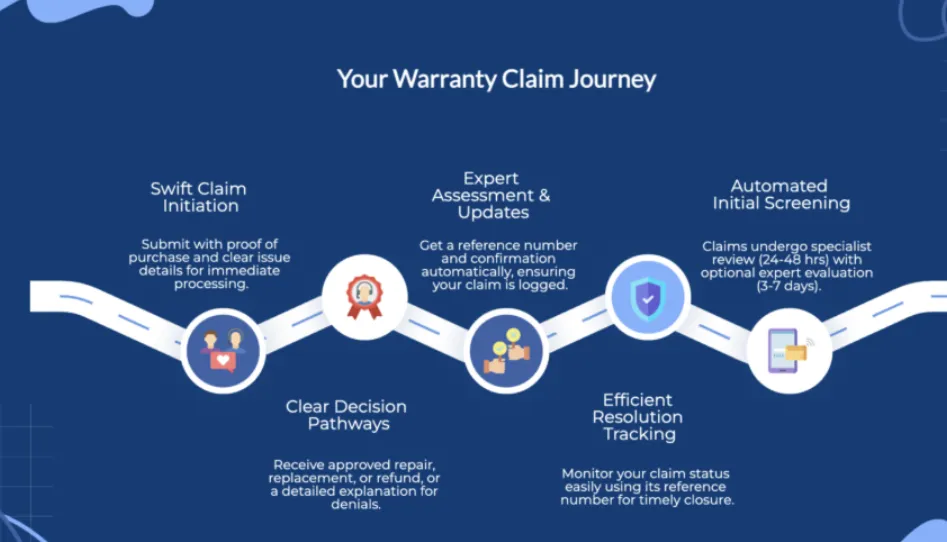
The following framework outlines the core components of a functional warranty claims administration system — what each stage involves, why it matters, and how the decisions made at each point affect the overall reliability of the process.
What Warranty Claims Administration Actually Involves
Warranty claims administration refers to the end-to-end process of receiving, evaluating, approving or denying, fulfilling, and financially reconciling warranty service requests. It is not simply a customer service function. It sits at the intersection of operations, finance, legal, and field service — and its effectiveness depends on how well those functions are aligned around a shared set of rules and expectations.
For companies that want a structured starting point, the Warranty Claims Administration guide provides a working framework for understanding how these processes are sequenced and where the most common operational gaps tend to appear. The value of reviewing such resources lies not in replacing internal expertise, but in confirming whether existing processes reflect industry-standard practice.
At its core, warranty claims administration involves four broad functions: intake and documentation, eligibility determination, service fulfillment, and financial processing. Each of these functions carries distinct risks if handled inconsistently, and each requires clearly defined ownership within the organization.
The Gap Between Policy and Process
Many product companies invest considerable effort in drafting clear warranty policies, only to find that those policies are applied inconsistently once claims begin arriving. The written warranty establishes the legal boundary — what is covered, for how long, and under what conditions. But the claims process is where that policy becomes operational reality.
When the process is vague or undocumented, different team members may interpret coverage eligibility differently, approve claims that fall outside scope, or deny legitimate claims because the right information was not available at the point of decision. This inconsistency has a compounding effect: it creates financial unpredictability, generates customer friction, and makes it difficult to identify patterns in product failures that could inform engineering or quality improvements.
Building a Claims Intake System That Captures the Right Information
The intake stage is where the quality of the entire process is either established or undermined. A warranty claim that enters the system without complete documentation — proof of purchase, product identification, failure description, installation or usage context — will create delays and disagreements at every subsequent stage.
An effective intake system standardizes what information is collected at the first point of contact, regardless of how the claim is submitted. Whether a customer calls a service line, submits a form online, or contacts a dealer or distributor, the same data set should be captured. This consistency reduces back-and-forth communication, shortens resolution timelines, and creates a cleaner record for financial processing later.
Documentation Requirements and Why They Matter Downstream
Documentation at intake serves multiple purposes beyond just confirming eligibility. It creates an evidentiary record that can support or refute the claim at any point during the process. It also provides the raw data needed for warranty cost analysis, supplier recovery claims, and product liability assessments.
Companies that treat documentation as a formality rather than a functional requirement often find themselves unable to recover costs from component suppliers when a product defect is traced back to a specific part or material. Under the Federal Trade Commission’s warranty regulations, certain documentation practices are not merely operational preferences — they reflect legal obligations that product companies must meet when offering written warranties to consumers in the United States.
The intake process should capture, at minimum, the following elements:
• Product serial number and model identification to confirm the specific unit involved and its manufacturing history
• Date of original purchase or installation, supported by verifiable proof, to confirm that the claim falls within the coverage period
• A detailed description of the failure or defect as reported by the claimant, including when it was first observed and under what conditions
• Any prior service history, repairs, or modifications that could affect coverage eligibility or shift responsibility to a third party
• Contact and location information for the claimant and, where relevant, the installing or servicing contractor
Eligibility Determination: The Decision That Defines the Process
Once a claim has been submitted and documented, the eligibility determination stage establishes whether the claim falls within the scope of the warranty as written. This is where the process either holds its integrity or begins to break down. Eligibility errors — approving claims that should be denied, or denying claims that are legitimate — generate costs in both directions: unnecessary payouts and unnecessary disputes.
Eligibility determination should follow a structured decision logic that mirrors the terms of the written warranty. This means evaluating coverage period, covered components, exclusions, and any conditions related to installation, usage, or maintenance that the warranty specifies. The person making this determination needs access to the complete claim record, the relevant product warranty document, and ideally a decision support tool or checklist that reduces the influence of individual judgment on what should be a policy-driven outcome.
Handling Borderline Claims Without Creating Precedent Problems
Some claims do not fit neatly into an approved or denied category. The failure may be partially attributable to user error, a borderline installation issue, or a product characteristic that sits at the edge of what the warranty was designed to address. These borderline cases require careful handling because the decision made in one case can be cited in future claims as an informal precedent.
Companies should have an escalation path for ambiguous claims — typically involving a product engineer, legal counsel, or a senior operations manager — rather than leaving frontline staff to make judgment calls that have long-term implications. All escalated decisions should be documented with clear reasoning, both to support consistency and to protect the company in the event of a dispute.
Service Fulfillment: Coordinating Repair, Replacement, and Field Response
Once a claim is approved, the fulfillment stage determines how quickly and effectively the customer’s issue is resolved. For product companies that rely on authorized service networks, this stage involves coordinating between internal teams, third-party service providers, parts suppliers, and sometimes the customer directly.
The primary risk at this stage is the gap between approval and completion. An approved claim that sits in a queue waiting for parts availability or technician scheduling reflects poorly on the company regardless of the contractual resolution timeline. Customers measure their experience from the moment the problem occurs, not from the moment the claim is approved.
Managing Third-Party Service Providers Within the Warranty Framework
Many product companies do not employ their own field service technicians. Instead, they maintain networks of authorized service providers — independent contractors, dealers, or regional service firms — who perform warranty repairs on their behalf. This arrangement introduces a layer of process complexity that requires its own governance structure.
Third-party providers need to understand the warranty terms they are servicing against, the documentation requirements for the work they perform, and the billing and reimbursement process for labor and parts. Without clear onboarding, consistent communication, and defined service standards, the quality of warranty fulfillment across the network will vary significantly — and those variations will ultimately appear in customer satisfaction data, cost reports, and product failure analyses.
Financial Reconciliation and Warranty Cost Management
The financial dimension of warranty claims administration is often where operational shortcomings become most visible. Every approved claim represents a cost that was anticipated — at least in principle — when the product was priced and the warranty was written. But if the claims process is not generating accurate, timely financial data, the actual cost of honoring warranty obligations can diverge significantly from projections.
Reconciliation involves matching approved claims against completed service events, validating the costs submitted by service providers, processing supplier recovery claims for defective components, and updating warranty reserves in the financial reporting cycle. Each of these steps depends on the accuracy of the documentation collected at intake and throughout the fulfillment process.
Using Claims Data to Reduce Future Costs
One of the most underused benefits of a well-structured warranty claims administration process is the operational intelligence it generates. Claims data reveals patterns in product failures that are not visible through standard quality control processes. A component that fails consistently under a specific set of conditions, or a service error that appears repeatedly in the same geographic market, are problems that can be addressed before they generate additional claims.
Companies that review warranty claims data systematically — by product line, failure type, service region, and age of the product at time of claim — are better positioned to make informed decisions about design changes, supplier performance, installation standards, and warranty term adjustments. This feedback loop between warranty operations and product development is one of the clearest ways that a mature claims process contributes to long-term cost reduction.
Closing Thoughts: Why Process Maturity Determines Warranty Outcomes
Warranty claims administration is not a back-office formality. It is a structured operational function that directly affects product costs, customer retention, supplier relationships, and legal compliance. Companies that treat it as such — investing in clear documentation standards, decision logic, service network governance, and financial reconciliation — consistently achieve better outcomes than those that manage claims reactively.
The framework described here is not a one-size-fits-all prescription. Every product company operates under different warranty structures, service models, and customer expectations. But the underlying principles — consistency, documentation, clear eligibility logic, coordinated fulfillment, and data-driven financial management — apply across industries and product categories.
Building a mature warranty claims process takes time and requires cross-functional commitment. But the companies that do it well find that the process pays for itself through reduced disputes, better supplier recovery rates, lower per-claim costs, and customers who are more likely to remain loyal because their warranty experience reflected the quality of the product that was sold to them.

I’m Leo Knox, the wordplay wizard behind WordsTwists.com where I turn everyday meanings into funny, clever, and creative twists. If you’re tired of saying things the boring way, I’ve got a better (and funnier) one for you!