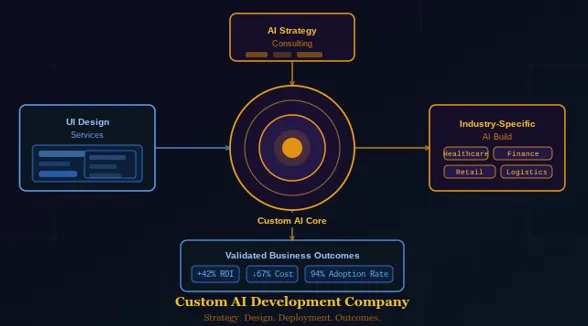
There is no shortage of vendors willing to help a business “implement AI.” The harder question is whether what gets built will actually solve the right problem, survive contact with real users, and hold up under the demands of production at scale. That question is what separates a capable custom AI development company from a team that can ship a demo. And for businesses making a significant investment in AI right now, the difference in outcome between those two things is enormous.
The companies that get the most out of AI are not necessarily the ones with the biggest budgets or the most advanced internal teams. They are the ones that found a partner who understood their specific business problem before touching a line of code, and who built something shaped around that problem rather than around what was convenient to build.
What “Custom” Actually Means in AI Development
The word custom gets used loosely. A lot of what passes for custom AI is little more than a pre-built model wrapped in a branded interface with some prompt tuning applied. That approach can work for narrow, low-stakes applications. For anything that needs to handle real organizational complexity, integrate with existing workflows, or produce outputs that carry business weight, it falls short quickly.
A genuine custom AI development company builds from the problem outward. The data infrastructure, the model architecture or selection, the retrieval and grounding mechanisms, the evaluation framework, and the interface all reflect the actual requirements of the use case rather than a template that was repurposed from a previous project.
At BayOne, this means the first stage of any engagement is understanding the business problem in enough depth to know what kind of AI is actually appropriate, what data exists to support it, and what success looks like in concrete, measurable terms. That foundation shapes every technical decision that follows.
AI Strategy Consulting as the Starting Point
The single most important factor in whether an AI investment pays off is whether it was aimed at the right target to begin with. This is what AI strategy consulting addresses, and it is why serious custom AI development companies lead with strategy rather than treating it as optional.
AI strategy consulting maps the gap between where a business currently operates and where AI can create genuine leverage. This involves auditing existing processes to identify where repetitive, high-volume, or judgment-intensive tasks could be partially or fully supported by AI. It involves examining data availability, quality, and governance to understand what is realistically buildable. It involves defining success criteria that connect to business outcomes rather than model benchmarks. And it involves prioritizing the use cases that offer the highest return for the effort and risk involved.
Without AI strategy consulting, development teams are flying without instruments. They build toward assumptions rather than evidence, and the gap between what was built and what the business actually needed only becomes visible after the investment has been made. That is an expensive way to learn.
The Scope of Work a Custom AI Development Company Covers
A full-scope AI development engagement with BayOne covers more workstreams than most clients initially anticipate. The technical build is one part. The surrounding infrastructure that makes it viable in production is another. Here is what a well-run engagement typically includes:
- Problem definition and feasibility assessment to confirm the use case and validate that the data required to support it actually exists in a usable form
- AI strategy consulting to prioritize use cases, define governance requirements, and establish evaluation criteria before development begins
- Data pipeline design covering ingestion, cleaning, transformation, and the retrieval architecture that gives the model access to organizational knowledge
- Model selection and configuration across open-source and proprietary options based on the task requirements, cost profile, and deployment environment
- Prompt architecture and output design so the model produces structured, consistent responses that can be used downstream without heavy post-processing
- UI design services to build the interaction layer that users actually encounter, covering input patterns, output presentation, onboarding flows, and error states
- System integration connecting AI outputs to the tools, platforms, and workflows that users are already operating within
- Testing and quality evaluation covering both technical performance and user-facing behavior before the system goes live
- Post-launch monitoring tracking output quality, latency, cost, and adoption over time
Why UI Design Services Belong at the Center of Every AI Project
An AI system is only as useful as the interface through which people interact with it. This is not a minor consideration. The gap between a technically capable AI product and one that achieves genuine adoption is almost always a design gap, not a model gap.
UI design services in the context of AI development address problems that do not exist in conventional software. Generative AI outputs are variable in ways that users need help interpreting. The input interface needs to guide users toward effective prompting without requiring them to become prompt engineers. Error states and low-confidence outputs need to be communicated clearly without destroying trust in the system.
When UI design services are integrated into the AI development process rather than added at the end, the interface is built around how the model actually behaves, not how the team hoped it would behave during planning. Design decisions are informed by real output characteristics, which produces interfaces that handle edge cases gracefully rather than exposing them to users as failures.
Evaluating a Custom AI Development Company
The market for AI development services has grown fast, and the quality variance across providers is significant. When evaluating a custom AI development company, the most important criteria are not the ones on the front page of a case study.
Step 1: Confirm That AI Strategy Consulting Comes Before the Build
Ask any prospective partner how they start an engagement. If the answer skips straight to model selection or technical scoping, that is a red flag. A serious custom AI development company treats AI strategy consulting as a prerequisite, not an optional service tier. Partners who bypass the strategy phase are optimizing for short project timelines, and that shortcut almost always costs the client more downstream.
Step 2: Verify Full-Stack Capability, Including UI Design Services
A development partner that only covers model building leaves the rest of the product for someone else to figure out. That gap, between what the model produces and what a user can actually interact with, is where AI projects most commonly stall. Confirm that UI design services are part of the offering and that design and engineering work together throughout the project rather than in sequence.
Step 3: Match Domain Experience to Your Industry
AI systems built for healthcare, financial services, legal, or manufacturing carry compliance, explainability, and integration requirements that a generalist AI shop frequently underestimates. Ask specifically about prior work in your vertical, the regulatory constraints the team has navigated, and how those shaped the architecture of what they built. Generic case studies are not a substitute for genuine domain depth.
Step 4: Demand a Post-Launch Support Model
AI products need ongoing attention in ways that conventional software does not. Base models update and change output behavior. Knowledge bases need to stay current. User feedback surfaces gaps that pre-launch testing did not catch. A partner who hands over a repository and moves on is not equipped to support what they built. Confirm what the engagement looks like after go-live before signing anything.
What Good Looks Like After Launch
The measure of a custom AI development company is not whether they can ship something. It is whether what they ship continues to perform three, six, and twelve months after launch. That requires output quality monitoring, periodic re-evaluation of model behavior as base models update, user feedback loops that surface emerging friction points, and a clear ownership structure for ongoing improvements.
Businesses that build AI with BayOne get a partner across that full lifecycle, not a vendor who hands over a repository and moves on. That continuity is what allows AI investments to compound in value rather than plateau.
Frequently Asked Questions
What distinguishes a custom AI development company from a general software development firm offering AI services?
A specialist custom AI development company has dedicated expertise in model selection, retrieval-augmented generation, prompt architecture, output evaluation, and AI-specific system design. General software firms often treat AI as a feature addition to conventional development projects. The distinction matters because AI systems have failure modes, data requirements, and governance considerations that standard software engineering practices were not designed to handle.
How does AI strategy consulting reduce risk in an AI development project?
AI strategy consulting identifies the right use cases before development begins, validates that the data needed to support those use cases is available and usable, and defines success criteria that connect to real business outcomes. Without this foundation, teams frequently build toward the wrong target and discover the misalignment only after the investment has been made. AI strategy consulting front-loads the thinking that prevents expensive rework later in the process.
Why are UI design services considered essential in a custom AI development engagement?
AI systems are probabilistic and produce variable outputs that users need help interpreting. UI design services shape the input interface to guide effective use, format outputs so they are immediately actionable, and design error states that preserve user trust when the model misses. Without purpose-built UI design services, technically capable AI produces experiences that frustrate users, limit adoption, and undermine the business case for the investment.
What industries does BayOne serve as a custom AI development company?
BayOne brings experience across healthcare, financial services, retail, logistics, and enterprise technology, among other verticals. Each industry carries specific requirements around data governance, compliance, and integration that shape the architecture of an AI system in significant ways. Engaging a custom AI development company with relevant domain experience reduces the risk that industry-specific constraints are discovered mid-build rather than planned for from the start.

I’m Leo Knox, the wordplay wizard behind WordsTwists.com where I turn everyday meanings into funny, clever, and creative twists. If you’re tired of saying things the boring way, I’ve got a better (and funnier) one for you!