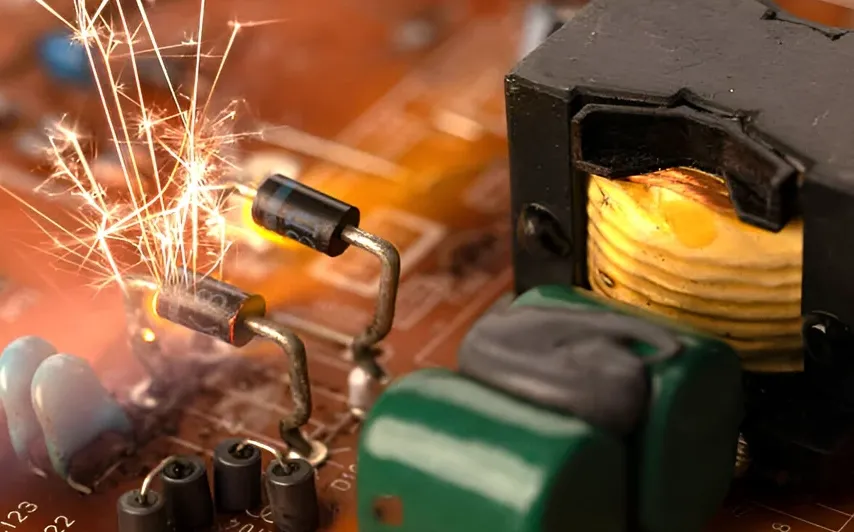
Twelve-volt electronic projects are widely perceived as low risk. The voltage feels manageable, components are easy to source, and early prototypes often work without issue. Problems usually emerge later, after extended runtime or real-world use, when heat buildup begins to affect reliability. Unlike dramatic electrical failures, overheating develops quietly. Systems continue operating while internal temperatures climb, materials degrade, and margins disappear.
Overheating in 12V projects is rarely caused by a single defective part. It is almost always the result of control decisions made early in design—choices that seem reasonable individually but combine to create sustained thermal stress. The following mistakes represent common patterns seen across hobby, industrial, and embedded low-voltage systems where power control was underestimated.
Why power control quality determines thermal stability
In low-voltage systems, current flow is the primary driver of heat. Every inefficiency, resistive loss, and switching event converts electrical energy into thermal energy that must be dissipated. When power delivery is poorly controlled, heat concentrates in predictable places: switching devices, conductors, connectors, and enclosed spaces.
Designs that rely on a 12v 8amp pwm controller illustrate this clearly. PWM control improves flexibility and efficiency, but it also introduces switching losses and localized heat generation that demand careful thermal consideration. When control decisions ignore these realities, overheating becomes inevitable.
Why overheating often goes unnoticed at first
Thermal problems build gradually.
- Systems pass initial testing
- Failures appear only after long runtime
- Cooling periods temporarily restore function
This delay makes root causes harder to identify.
1. Assuming low voltage automatically means low heat
One of the most common misconceptions is equating low voltage with low thermal risk. While 12V systems reduce shock hazard, they often require higher current to deliver useful power. Heat generation increases with current and resistance, not voltage alone.
This assumption leads to undersized components and insufficient cooling.
Why this mistake is persistent
Voltage is visible; current is not.
- Designers focus on nominal voltage ratings
- Current paths are underestimated
- Losses scale quietly with load
The result is steady heat accumulation under normal operation.
2. Ignoring switching losses in PWM control
PWM control reduces average power delivery, but it does not eliminate heat. Each switching event dissipates energy in transistors and drivers. At higher currents, these losses become significant, even if duty cycles are modest.
Designs often account for conduction losses but ignore switching behavior.
How switching losses create hotspots
- Heat concentrates in control devices
- Thermal stress is localized, not uniform
- Failure begins at the switching stage
Without adequate heat sinking or airflow, these hotspots dominate system temperature.
3. Undersizing conductors and PCB traces
Wires and PCB traces are frequently sized based on average current rather than sustained load. In 12V systems, small increases in resistance generate noticeable heat when current is continuous.
This mistake is especially common in compact designs.
Why conductor heating is underestimated
- Resistance changes with temperature
- Poor layout increases path length
- Heat accelerates further resistance growth
Once heating begins, it reinforces itself.
4. Overlooking connector and joint resistance
Connectors, crimps, and solder joints are often treated as electrically ideal. In reality, they are common sources of resistance and heat, especially as they age or experience vibration.
Poor connections create localized heating that spreads to surrounding components.
How connection quality affects system temperature
- Minor resistance increases generate heat
- Heat degrades contact surfaces
- Failures become intermittent
Connector-related heating is a frequent but overlooked cause of instability.
5. Using linear control where switching control is required
Linear regulators and resistive control methods are simple but inefficient. In 12V systems delivering several amps, linear control converts excess voltage directly into heat.
This approach quickly overwhelms thermal capacity.
Why linear control fails at higher currents
- Heat output scales with voltage drop
- Efficiency declines under load
- Cooling requirements increase sharply
Many overheating issues trace back to this fundamental mismatch.
6. Designing enclosures without thermal escape paths
Compact enclosures are attractive for cost and packaging reasons, but they trap heat. Plastic housings insulate rather than dissipate, and sealed designs restrict convection.
Without intentional thermal paths, heat has nowhere to go.
Common enclosure-driven mistakes
- No ventilation or heat sinking
- Components packed too tightly
- Heat sources clustered together
Electrical performance may be adequate while thermal performance is not.
7. Failing to account for ambient temperature
Bench testing often occurs at room temperature. Real-world environments may be significantly warmer. As ambient temperature rises, the system’s ability to shed heat declines.
Designs that ignore this reality operate on borrowed margin.
Why ambient conditions matter
- Heat transfer depends on temperature difference
- High ambient reduces cooling effectiveness
- Margins disappear silently
Field failures often trace back to this oversight.
8. Relying on efficiency numbers instead of thermal behavior
Efficiency improvements reduce total losses, but they concentrate heat into fewer components. High-efficiency designs often use smaller, more stressed devices.
This shifts, rather than removes, thermal risk.
The efficiency paradox
- Fewer losses overall
- Higher thermal density locally
- Localized failures increase
Thermal design must evolve alongside efficiency gains.
9. Skipping extended runtime testing
Short tests rarely reveal thermal issues. Overheating often appears only after hours of continuous operation, once thermal equilibrium is reached.
Skipping this testing allows latent failures into deployment.
What long-duration testing reveals
- Slow temperature rise trends
- Hotspots under sustained load
- Interaction between components
Without this data, designs remain thermally unproven.
10. Treating thermal design as an afterthought
Perhaps the most damaging mistake is addressing heat only after problems appear. Adding fans or heat sinks late rarely solves root causes.
Thermal behavior must be considered alongside electrical design.
Why late fixes fall short
- Root causes remain active
- Added cooling increases complexity
- Reliability remains unpredictable
Early thermal intent prevents these outcomes.
Why overheating failures appear inconsistent
Thermal failures often look random because they depend on time, load, and environment. Systems may work flawlessly one day and fail the next under identical electrical conditions.
This inconsistency complicates diagnosis.
Patterns that indicate thermal root causes
- Failures worsen with runtime
- Cooling periods restore function
- Replacement parts fail similarly
Recognizing these patterns shortens troubleshooting cycles.
Heat behavior in electronics context
Heat in electronic systems follows basic physical principles. Electrical losses convert directly into thermal energy, which must be dissipated through conduction, convection, or radiation. A general explanation of these mechanisms is outlined in Wikipedia’s overview of heat transfer, which describes how heat moves through materials and environments.
These principles apply regardless of voltage level.
Designing 12V systems with thermal discipline
Reliable low-voltage design requires treating heat as a primary constraint.
Effective approaches include:
- Distributing heat sources
- Minimizing resistive losses
- Providing clear thermal paths
- Testing under real conditions
These steps reduce long-term risk more effectively than reactive fixes.
Why power control decisions matter most
In many 12V projects, power control choices determine where and how heat is generated. Poor control concentrates losses; thoughtful control spreads them.
This distinction defines whether a system ages predictably or fails unexpectedly.
Closing perspective: overheating is a design outcome, not a surprise
Overheating in 12V electronic projects is rarely accidental. It is the predictable outcome of decisions that undervalue current flow, switching behavior, and thermal limits. Voltage alone does not define safety or reliability. Heat does.
Designs that address power control and thermal behavior together remain stable over time. Those that treat heat as secondary often fail quietly, then suddenly. In low-voltage systems, reliability is not determined by whether a circuit works on day one, but by whether it manages heat every day thereafter.

I’m Leo Knox, the wordplay wizard behind WordsTwists.com where I turn everyday meanings into funny, clever, and creative twists. If you’re tired of saying things the boring way, I’ve got a better (and funnier) one for you!