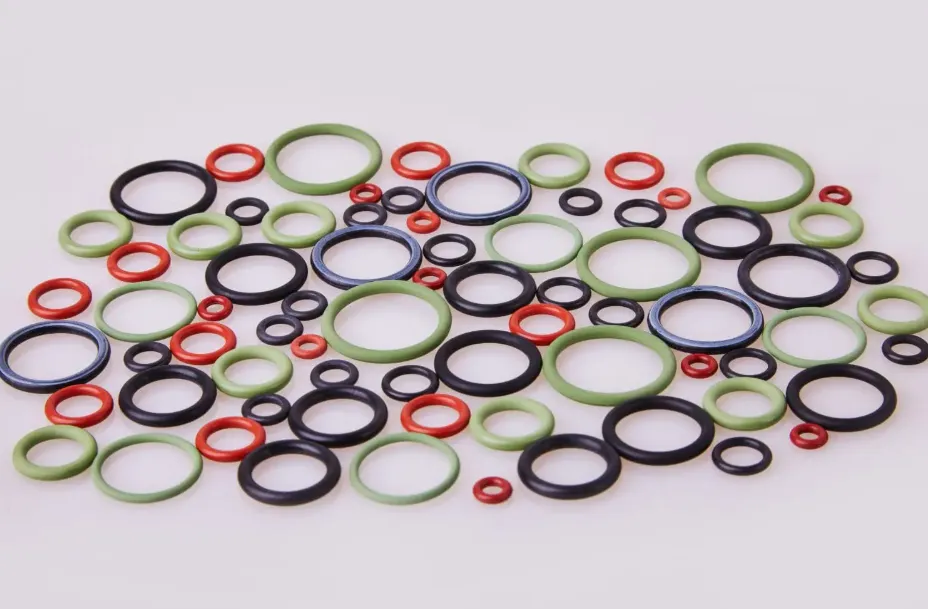
In many industrial environments, O-rings are treated as standardized consumables. They are specified early, ordered in bulk, installed quickly, and replaced when leaks appear. This approach works reasonably well in stable systems where operating conditions remain narrow and predictable. Problems begin when equipment is pushed harder, exposed to a wider range of fluids, or expected to run longer between maintenance intervals.
What often surprises engineering and maintenance teams is how disproportionately O-ring material choice influences overall system reliability. Failures attributed to “normal wear,” installation error, or bad batches frequently trace back to a material that is technically compatible on paper but unstable under real operating conditions. The impact is rarely immediate. It accumulates quietly through shortened seal life, unpredictable leakage, and increasing maintenance intervention.
Understanding why material choice matters requires looking beyond unit cost and part availability, and instead examining how elastomers behave over time under heat, pressure, and chemical exposure.
O-ring material as a reliability boundary, not a commodity
An O-ring functions by controlled deformation. It must compress enough to seal, resist permanent deformation, tolerate contact with process media, and recover repeatedly without losing elasticity. These behaviors are governed almost entirely by material chemistry and structure.
For teams evaluating a Viton O-ring Supply guide, the key realization is that material selection defines the boundary between predictable operation and recurring failure. Once operating conditions consistently push past what a material can tolerate, reliability declines regardless of installation quality or maintenance discipline.
Why reliability issues are often misattributed
Material-driven failures are easy to misdiagnose.
- Seals appear to fit correctly at installation
- Initial operation may be leak-free
- Degradation develops internally or gradually
By the time problems become visible, the material has often already lost critical properties.
The hidden ways material behavior shapes system outcomes
Material choice influences how an O-ring responds to stress long before failure occurs. Heat accelerates aging, chemicals alter molecular structure, and pressure cycling introduces fatigue. Each of these mechanisms changes how the seal behaves under load.
Unlike hard components, elastomers do not fail at a single threshold. They drift away from intended behavior, narrowing safety margins until small variations trigger leaks.
Reliability loss is progressive, not sudden
Most seal-related downtime follows a pattern.
- Early service life appears normal
- Replacement intervals shorten gradually
- Failures become clustered rather than random
This progression reflects material behavior under cumulative stress.
Heat exposure reveals material limitations quickly
Temperature is one of the most influential variables in seal reliability. Elevated heat accelerates oxidation, hardening, and compression set in many elastomers. Materials that perform acceptably at moderate temperatures may lose elasticity rapidly once heat exposure increases in duration or intensity.
In facilities where throughput increases or equipment duty cycles extend, heat exposure often changes without a corresponding update to sealing specifications.
How heat changes failure modes
As elastomers age thermally:
- Elastic recovery declines
- Cracks form during cooling cycles
- Sealing force decreases under constant compression
Leaks that appear temperature-dependent are often early indicators of material stress rather than mechanical defects.
Chemical compatibility goes beyond the process fluid
Chemical exposure is rarely limited to the primary process medium. Cleaning agents, flushing fluids, lubricants, and environmental contaminants all interact with O-ring materials. A seal compatible with the main fluid may still degrade when exposed intermittently to secondary chemicals.
Material swelling, extraction of additives, or surface attack alters both dimensions and mechanical properties.
Why partial compatibility still causes failure
Chemical effects compound over time.
- Swelling increases friction and wear
- Degradation reduces tensile strength
- Deformed seals fail to reseat properly
Compatibility must account for every fluid the seal encounters, not just the one listed in process documentation.
Compression set and loss of sealing force
Compression set is a measure of how well an elastomer returns to its original shape after prolonged compression. Materials with poor compression set resistance flatten over time, reducing contact pressure against sealing surfaces.
This failure mode is especially critical in static seals that remain compressed for long periods.
Operational impact of compression set
Loss of recovery reduces tolerance.
- Small surface imperfections become leak paths
- Pressure fluctuations overcome reduced sealing force
- Seals fail earlier than planned
Material choice directly influences long-term sealing consistency.
Aging behavior determines predictability
All elastomers age, but the rate and mechanism vary widely. Heat, oxygen, and chemical exposure accelerate aging processes that change hardness, elasticity, and resilience. Aging is cumulative and often nonlinear, with long periods of apparent stability followed by rapid decline.
This behavior explains why failures sometimes appear sudden even when no operating parameters have changed.
Why aging undermines maintenance planning
Unpredictable aging complicates reliability management.
- Inspection intervals become unreliable
- Preventive replacement increases
- Failure risk rises between planned outages
Materials with stable aging characteristics support more predictable maintenance strategies.
Dynamic applications amplify material differences
In dynamic seals, O-rings experience relative motion against mating surfaces. Materials not designed for dynamic contact wear quickly, generating debris that accelerates further damage. Heat and friction amplify this effect.
Material choice determines whether wear progresses slowly or accelerates rapidly.
Consequences of dynamic wear
Wear introduces secondary problems.
- Particles contaminate fluids
- Surface roughness increases friction
- Seal life shortens disproportionately
Dynamic applications demand materials with appropriate abrasion resistance and elasticity.
The misconception that cost drives reliability
A common assumption is that lower-cost materials offer acceptable performance if replaced more frequently. In practice, frequent replacement introduces variability, increases labor exposure, and raises the risk of installation errors.
The true cost of seal failure includes downtime, cleanup, and potential damage to adjacent components.
Evaluating cost across the system lifecycle
Reliability cost extends beyond parts.
- Unplanned stoppages disrupt production
- Maintenance labor increases
- Equipment damage escalates
Material stability often has a greater impact on total cost than unit price.
Why familiar materials are often overused
Facilities tend to standardize on materials that have “worked before.” As operations evolve, these materials may operate closer to their limits without being reevaluated. Familiarity can mask the need for reassessment.
Material suitability should be reviewed when:
- Operating temperatures increase
- New fluids are introduced
- Maintenance intervals are extended
Ignoring these changes allows reliability margins to erode quietly.
Material behavior in a broader engineering context
Elastomer performance is governed by polymer chemistry and environmental interaction. Different material families respond differently to heat, chemicals, and aging. A general explanation of how elastomers behave under stress is available in Wikipedia’s overview of elastomers, which describes how elasticity, degradation mechanisms, and resistance properties vary across materials.
This context helps explain why seemingly minor material differences lead to large reliability outcomes.
Why reliability teams often encounter recurring seal failures
Recurring failures are rarely random. They indicate that operating conditions consistently exceed material capability. Replacing seals with the same material treats symptoms rather than causes.
Patterns worth noting include:
- Failures concentrated in high-heat zones
- Leaks appearing after cleaning cycles
- Shortening service life without design changes
Each pattern points toward material mismatch rather than mechanical defect.
Aligning material selection with operating reality
Effective material selection begins with accurate definition of real conditions.
- Actual temperature range over time
- Complete list of process and cleaning fluids
- Static versus dynamic motion
- Pressure variability and cycling
Matching these factors to material behavior restores predictability.
Why higher-performance materials restore reliability
Higher-performance elastomers are not inherently “better” in all cases. They are more stable under specific stresses. When applied appropriately, they reduce failure modes rather than eliminate maintenance entirely.
The benefit is not zero failure, but controlled, predictable behavior.
Operational benefits of proper alignment
- Longer service life
- Fewer unplanned leaks
- More stable maintenance schedules
Reliability improves because variability decreases.
When reassessment becomes unavoidable
Facilities often tolerate recurring seal issues until the operational cost becomes visible. The turning point usually occurs when downtime or maintenance effort begins to affect production planning.
At that stage, reassessment is no longer optional.
Closing perspective: small material choices shape large reliability outcomes
O-rings may be among the smallest components in industrial systems, but their material behavior has an outsized influence on reliability. Heat, chemicals, pressure, and time expose the limits of general assumptions, turning minor mismatches into recurring failures.
Material choice is not a procurement detail. It is an engineering decision that defines how systems behave under stress. Teams that recognize this early regain control over maintenance cycles, reduce unexpected downtime, and restore predictability to operations. In environments where reliability matters, aligning O-ring material with operating reality is one of the most effective ways to prevent small components from becoming persistent sources of disruption.

I’m Leo Knox, the wordplay wizard behind WordsTwists.com where I turn everyday meanings into funny, clever, and creative twists. If you’re tired of saying things the boring way, I’ve got a better (and funnier) one for you!