

Introduction
Precision deficits and delivery delays always disturb the automotive manufacturing sector, contributing to massive rework rates as high as 15%. This is a critical issue regarding vehicle performance and safety. Such problems most often originate from the constraints of traditional 3 axis CNC milling, since this is the method that cannot work with intricate geometry and tends to accrue errors over multiple setups. The answer to these limitations consists of embracing state-of-the-art 5 axis CNC milling capability, which is able to process materials from multiple angles in a single fixture, thus improving precision and efficiency.
This article illustrates how 5-axis CNC milling is transforming automotive parts manufacturing and why it’s indispensable for modern innovation in the automotive industry.
What is 5-Axis CNC Milling, and How Does It Outperform 3-Axis Technology?
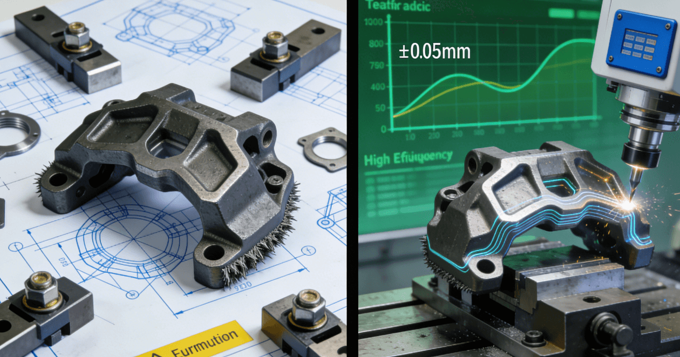
5 axis CNC milling refers to an advanced machining process where the cutting tool moves along five axes simultaneously: three linear (X, Y, Z) and two rotational (A and B). This allows the tool to approach the workpiece from virtually any direction, eliminating the need for repositioning. In contrast, 3 axis CNC milling is confined to linear movements, often requiring multiple setups for complex parts. Each repositioning introduces alignment errors, resulting in cumulative tolerances that can reach ±0.05mm. For automotive components like engine brackets, 5-axis technology achieves precision levels of ±0.005mm, reducing errors by 90% compared to 3-axis methods.
A relevant confirmation of these benefits can be seen in a report by the International Academy for Production Engineering (CIRP), where it says that 5-axis machining can cut the amount of setup time by 40% by combining procedures. This is very important for critical components, for instance, transmission housings, for which size accuracy can have a significant effect on safety. Five axes are very effective in the production of deep cavities and undercuts, typical for contemporary automotive models. For a detailed comparison, refer to this guide: 3 Axis vs 5 Axis CNC Milling Guide.
The integration of 5-axis machining into CNC machining services offers a leap forward in capability, allowing for the continuous processing of complex surfaces and deep cavities that are challenging with 3-axis machines, thereby boosting precision and slashing lead times.
Why Must Automotive Parts Manufacturing Pursue High-Precision CNC Milling?
Precision manufacturing is non-negotiable in the automotive industry, where components must adhere to rigorous safety standards and lightweight design requirements.
The Imperative of Standards and Risk Mitigation
Automotive-precise manufacturing necessitates uncompromising safety legislation and pursues light, efficient design. The enabling technology to meet such demands would be high precision CNC milling, thereby guaranteeing critical components such as brake calipers and transmission systems manufactured with extreme accuracy.
l Safety Compliance and Recall Prevention
In an automobile, failure of components can have disastrous effects. The accuracy of CNC milling precision is directly proportional to its reliability. The ISO 13053 standard regarding quality management processes emphasizes the fact that precision control of process quality can decrease defects by more than 30% in high-volume production. A variation in tolerance of ±0.01mm eliminates the probability of defective product operation, which is vital in preventing safety recalls.
l Quality Systems and Certification
To establish such a level of detail on a permanent basis, the industry leaders have established a quality management system. ISO 9001 certification is a mark of the framework established for the quality assurance process of the products. This process makes sure that each machined component complies with the required standards for the latest models of cars. Manufacturers committed to quality.
Tangible Benefits and Evolving Applications
The pursuit of high precision yields measurable performance improvements and is essential for next-generation automotive technologies. A practical example is a European car manufacturer which achieved a 20% extension of the life span of engine parts through the use of high-precision 5-axis machining, due to superior surface finishes and tighter tolerances that reduce wear.
Furthermore, the developments in electric vehicles (EVs) amplifies the need for precision. Battery housings, power electronics, and thermal management components require exact specifications for electrical insulation, cooling efficiency, and structural integrity.
How to Select Suitable CNC Milling Materials for Automotive Parts?
The choice of manufacturing materials directly impacts the performance and longevity of a CNC milling part. In automotive parts manufacturing, aluminum alloys are preferred for lightweight applications like engine blocks, offering a strong strength-to-weight ratio and corrosion resistance. Titanium, though costlier, is ideal for high-stress components like valve springs due to its exceptional durability under extreme temperatures.
5-axis CNC technology enhances material utilization by enabling complex Custom parts design, such as cooling channels in battery housings. For instance, aluminum 7075-T6 is often machined into intricate transmission parts with deep pockets, leveraging 5-axis capabilities to avoid tool interference. Designers must prioritize manufacturability during the prototyping phase, selecting materials that balance machinability with functional requirements. This approach reduces waste and ensures that components like turbine blades meet aerodynamic efficiency goals.
Are CNC Milling Services in China Truly Cost-Effective?
The rise of CNC milling service china has made cheap precision CNC milling accessible globally, with cost savings of up to 30% compared to Western counterparts. However, these savings must be balanced against quality controls. While China’s supply chain advantages include scalable production and lower labor costs, manufacturers must prioritize suppliers with ISO 14001 certification to avoid quality pitfalls.
Data from automotive tooling benchmarks indicate that Chinese suppliers reduce mold production costs by 28% through automated workflows. For example, a Tier-1 supplier achieved a 40% reduction in lead times for headlight molds by partnering with a certified Chinese vendor. To ensure consistency, businesses should opt for providers offering full-spectrum CNC machining services, from prototyping to post-processing. Explore options here: CNC milling services.
Therefore, the cost-effectiveness is not just about the initial price but the total value delivered, including consistent quality and reliable lead times, ensuring parts meet precise specifications required for automotive parts manufacturing.
How Does 5-Axis CNC Milling Enhance Automotive Manufacturing Efficiency? A Case Study
A case study involving brake caliper production demonstrates how 5 axis CNC milling slashes production cycles from 5 days to 2 days. By machining the entire component in one setup, the technology eliminates alignment errors and reduces manual handling. Real-time tool wear monitoring further ensures consistency, with CNC milling precision maintained within ±0.005mm across 10,000 units.
In another example, an EV manufacturer used 5-axis milling to produce battery cooling plates with complex internal channels. The process improved thermal efficiency by 25% while reducing material waste by 40%. As automotive designs evolve toward electrification, 5-axis technology supports the machining of lightweight composites and aluminum alloys, meeting OEM demands for durability and efficiency.
Case Study: Brake Caliper Production Transformation
This case study illustrates how 5 axis CNC milling has brought a revolutionary turn in manufacturing critical components related to safety.
l Radical Shortening of Production Lead-Time
Due to increased capability, since it facilitates the end-to-end machining of a brake caliper in a single workstation, it eliminates a number of fixture changes with their attendant alignment problems and brings about a reduction in the whole production cycle from 5 days to merely 2 days.
l Maintaining Precision in High Volume Runs
In addition to the speed achieved, there is consistency. The combined use of real-time tool wear measurement enables proactive adjustments, guaranteeing that CNC milling precision is rigorously maintained within ±0.005mm across high-volume production batches of 10,000 units or more, ensuring every part meets strict safety specifications.
H3: Enabling Electric Vehicle Innovation
The advantages of 5-axis technology are pivotal for next-generation electric vehicles (EVs). In one application, an EV manufacturer utilized this capability to produce intricate battery cooling plates featuring complex internal channels. This approach not only improved the thermal management system’s efficiency by 25% but also achieved a 40% reduction in material waste. As automotive design prioritizes electrification and lightweighting, 5-axis milling is essential for machining advanced materials like aluminum alloys and composites, directly meeting OEM demands for greater durability and energy efficiency.
Conclusion
5 axis CNC milling is redefining automotive parts manufacturing through unparalleled precision, reduced lead times, and cost-effective production. However, maximizing these benefits requires strategic material selection and partnerships with certified CNC machining services. As the industry shifts toward EVs and lightweighting, adopting 5-axis technology is no longer optional but essential for staying competitive.Optimize your component design with expert manufacturing insights. Click here to request a free manufacturing analysis for your parts.
H2:Author Biography
This article was authored by a precision manufacturing specialist with over a decade of experience in CNC innovation for automotive applications. The expert is part of JS Precision, a leader in advanced manufacturing solutions.
FAQs
Q1: Is 5-axis CNC milling suitable for small-batch production?
A: Yes, 5-axis technology reduces setup times, making it cost-effective for prototypes and small batches. Lead times can be as short as 1–2 weeks.
Q2: How is the accuracy of a CNC milled part validated?
A: Coordinate measuring machines (CMMs) verify dimensions against CAD models, ensuring compliance with standards like ISO 13053 and tolerances within ±0.005mm.
Q3: What are the common CNC materials for automotive parts?
A: Aluminum alloys (e.g., 6061) for lightweight parts and titanium for high-strength components. Material choice depends on design requirements.
Q4: How do Chinese CNC services ensure quality?
A: Reputable providers adhere to ISO 9001/14001, implement full-process quality control, and use CMMs for inspections.
Q5: What is the cost difference between 5-axis and 3-axis milling?
A: 5-axis machines entail 20% higher upfront costs but reduce total expenses by 30% through fewer setups and less material waste.

I’m Leo Knox, the wordplay wizard behind WordsTwists.com where I turn everyday meanings into funny, clever, and creative twists. If you’re tired of saying things the boring way, I’ve got a better (and funnier) one for you!

