

Introduction
In the gear production industry, there is a frustrating truth that engineers and designers must contend with. This is that material specification misinformation and pricing data obfuscation cause cost and time misallocations. To elaborate, specifying a material based on its hardness without its toughness properties might lead to rapid wear in highly loaded parts, and misinterpretations of technical vocabulary, such as part tolerance and precision, mislead material costs. The underlying issue is that experience instead of data standards have always governed this industry.
This article addresses these issues directly using industrial wordplay to interpret complex gear machining language. By relating important terminology to formal standards such as ISO 9001 and ASME Y14.5, we establish a clear guide for improving material selection and pricing. The next sections will examine the power of language play in applying technical jargon for your benefit, ensuring your gear project optimizes performance, robustness, and pricing.
What Are Some Potential Issues in Materials Used in Gears, and How Can Wordplay Rectify This?
The choice of gear material is more than an engineering decision – it’s a decision that affects durability, efficiency, and economics. Many pitfalls in gear material selection arise from a lack of understanding of certain technical terms. We will illustrate the pitfalls using a pinch of wordplay.
1. The “Hard” Truth: When Hardness Isn’t Enough
Engineers can also fall into a predisposition in believing “hardness” is simply the same thing as “durability.” In gear machining, though a material could be described as hard as nails, it might also be brittle when loaded. Let’s provide a play on a word: “hardness” can also relate to a material’s resistance to abrasions at its surface, but it doesn’t necessarily relate to its toughness and its capacity to withstand energy without breaking. For example, through-hardened steel can provide high hardness values, but in situations with shock loads, a material with superior impact strength, such as case-hardened steel, would actually provide better value through word play with hard vs. hardy.
2. Environment Oversights: Why “Wordplay” Warns Against One-Size-Fits-All
Gears are applied in various environments from high temperature engines to corrosive environments in a ship. A legendary mistake is the use of materials without taking into consideration the exposure to moisture or high temperatures. In this case, the play on words “gears in gears” from “gears” meaning engine parts and “gears” as preparation encourages “gearing up” in preparation for an environment. For example, the use of stainless materials in the case of corrosion may have low hardness but with trade-offs. Use of the standard from ISO 9001 recalls the avoidance of risk through systematic risk assessment or elements within quality.
3. Case Study: How a Pun-Powered Checklist Prevents Costly Errors
One such case in real-life examples involved gearing design engineers in the agricultural sector, who picked the material just on the strength of hardness values. Later, when they were encouraged by wordplay, as in “don’t gear yourself up for failure,” they changed their choice to one with superior resistance to fatigue, thus preventing early component failure and optimizing long-run maintenance by 20%. Custom gear machining services and other expert personnel help ensure consistency with established best practices in complex development projects.
How Gear Machining Terminology Affects Pricing Accuracy?
Precision gear machining requires precise communication, but word confusion can cause substantial variation in pricing. Where misunderstandings in wording such as “tolerance” and “surface finish” occur, vendors can quote higher in order to account for uncertainties. The usage of wordplay as a clarifier removes such discrepancies.
- The “Tolerance” Tango: Balancing Precision and Cost: In gear production, tolerance values significantly influence machining time and tools. A tight tolerance value (for example, ±0.01mm) may increase production costs by as much as doubling them. It is, therefore, necessary to ensure that there are no misunderstandings in tolerance values or convenient wordplays like “tolerance tango” between both parties to move in perfect sync. Citations from the guidelines in ASME Y14.5 ensure geometric dimensioning dimension tolerances are understood in unison.
- Material Waste and Machining Time: The “Cost-Twisting” Effect: Vague language such as “light finishing” or “high accuracy” lends itself to interpretation, thereby resulting in material wastage and prolonged machining time. For example, where a designer calls for “smooth surfaces” without defining the Ra values, the supplier can end up using a more conservative process by default. The use of innocently playful language such as “cost-twisting” in “twisting words twist costs” promotes accurate technical specification. This is supported by the fact that precise technical drawings lower the variance in quotes by as much as 30% in the aerospace industry where the use of IAQG specifications necessitates it.
- Clear Quotes: Wordplay as the Driver of Reasonable Pricing: A proper utilization of the RFQ (Request for Quote) process and standardized language avoids ambiguity. For example, the phrase “quality assurance” becomes “quality ‘assurance’ (not chance)” in a pun, clearly conveying that there must be tangible measures here. ISO 9001-certified suppliers can effectively offer quotes in accordance with clear-sounding specifications, thus avoiding any extra charges. Needless to say, this helps in creating credibility, which is achieved through proper communication.
What Role Does Material Hardness Play in Gear Durability and Performance?
Material hardness is a fundamental aspect of gear performance but is often wrongly interpreted. With the help of clever comparisons and convincing data visualization, we can investigate the role of hardness in gear performance in a fascinating manner.
1. Hardness Scales and Gear Life: The Rockwell Reality
Hardness, measured on scales such as Rockwell C, can give a measure of resistance to deformation. In gears, defined ranges of hardness (for example, 58-62 HRC) can preclude wear and pitting. Yet “hard numbers, soft risks” points out that hard gears can be brittle when made this way. There exist varying heat treatments, such as case hardening, for gears that require a tough core and hard surface through Wikipedia’s page on heat treating.
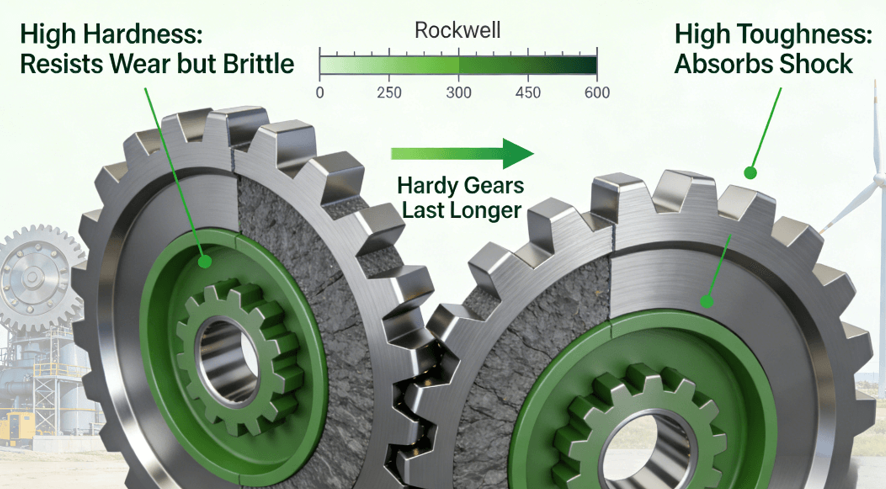
2. Hardness versus Toughness: Gear Duo
In gear parlance, toughness and hardness form conflicting pairs. Hardness may impair resistance to shock, causing cracks to occur. The trick that designers apply to counter this contradiction is based on a witty but apt simile: “Hardness fights wear; toughness fights tears.” As an illustration, a steel alloy with medium hardness and high toughness performs better under shock. Research within industry has established a positive correlation between such a combination and a shock-induced gear life extension of 40%.
3. Heat Treatment Wordplay: “Cool” Tricks for Better Gears
There are a number of heat treatment processes, like carburizing or quenching, that are essential in achieving a certain level of hardness. The words might have been made simpler using wordplay, like “quench” being similar to “drench” to imply a quick cooling process. The gear calculation is based on standards like ISO 6336 to guarantee reproducibility of results. Hardness is thereby assured to be beneficial but not detrimental to machinability.
Why is precision manufacturing so critical to custom gears?
Custom gears require micron-level precision to fit and function as intended. Precision manufacturing relies on standards, such as Geometric Dimensioning and Tolerancing-GD&T-to bring design intent into reality. Let’s decode its importance through clear, engaging language.
- GD&T: The Language of Precision: GD&T symbols, as stated in ASME Y14.5, are used to clearly communicate the design requirements without any ambiguity. For gears, features like tooth profile accuracy and bore concentricity are crucial. Concepts such as GD&T: Geometry Done Right go a long way in helping to establish wordplay on these terminologies. For example, position tolerance would imply that gears align perfectly during assemblies, which minimizes noise and vibration. In aerospace, where standards set by IAQG require stringent adherence, precision becomes non-negotiable.
- The Ripple Effect of Errors: Costly Consequences: One deviation in gear dimensional accuracy can translate into system failures, like increased wear or energy dissipation. Take, for example, misaligned gear systems. This could result in 15% more power being used. Analogy comparisons, gears that gossip, readily convey the need for gear accuracy. Statistical Process Control, found in ISO 9001, assists in controlling these factors.
- Certification as a Precision Guarantee: Having AS9100D or IATF 16949 approval from a manufacturer indicates that the processes are very controlled. When it comes to producing custom gear orders, it means that every process, from machining to inspecting, is documented. Precision with Proof reinforces the idea that in this instance, a badge is more than a label — moreover, it is a pledge of quality. So a client can be assured that their needs will be honored.
Ways in Which Quality Control Wordplay Can Improve Gear Reliability?
This is the essence of gear reliability, but quality control itself is complex and daunting. Wordplay brings quality control to life in memorable habits to avoid failures and increase trust.
1. SPC: Statistical Puns for Consistent Quality
Statistical Process Control (SPC) is a way of using data to foresee variations before they become defects. Phrases that are fun with SPC applied perfectly in SPC: Stop Problems Continuously. For gear manufacturing, the variables observed include the thickness of the tooth. Research shows that the use of SPC increases the rate of scrap by not more than 25% in a project.
2. Inspection Humor: Making Measurement Memorable
CMM scan results, including surface roughness tests, play a critical role in inspection methods. ‘Measure twice, cut once’ becomes ‘Measure with might, get it right.’ Based on the stress in ISO 9001 on objective evidence, it can be observed through a quotation on the use of humor: A gear measured against its ‘digital twin’ ensures compliance with specifications.
3. Quality as a Culture, Not a Checklist
Ultimately, What we find is that QC wordplay creates a quality-first attitude. Quality is queen — that kind of thing. When you say things like quality is queen instead of king, suddenly people get interested. When you have a certified facility with a quality is queen attitude, what you get is a reduced return rate and increased satisfaction.
How to Have the Smart Strategies for Balancing Gear Cost and Performance?
Attaining the optimum balance between price and performance calls for astute thinking. Value engineering, incorporating exact terminology, allows for informed decision-making without compromising quality.
1. Value Engineering: The “Cost-Smart” Approach
Value engineering is a process of evaluating all design variables to provide maximum value for the least expenditure. This could include using a lower-cost material that satisfies a certain requirement in gear design — e.g., using powdered metal in medium duty. Cost-twisting solutions — twist costs downward — demonstrates the use of creativity in minimizing expenditures. Articles about smart manufacturing from NIST note the use of technology to address these issues.
2. Standardization: Leveraging “Wordplay” for Efficiency
Use of standardized terms helps in avoiding any form of misinterpretation. For example, the ASME Y14.5 helps in preventing any differences in the terms “true position.” Humorous examples, such as “Standardize to Capitalize,” emphasize the savings of up to 20% gained through avoiding redesigns.
3. Future-Proofing with Data-Driven Decisions
Industry 4.0 adoption of data analytics and IoT-based monitoring enables real-time changes. Examples of wordplay include “gears that learn,” demonstrating adaptive machining techniques. Aligning with standards and utilizing expert services enables future-proofed production management at feasible costs for industry players.
Conclusion
Well-chosen terms in gear machining mean the issue is not simply about the word — it’s a resource for error prevention and optimization. Essentially, we have broken down the relationship among material choice, precision manufacturing processes, and quality control through authoritative guidelines in the form of ISO 9001 and ASME Y14.5 with the help of a dash of humor and clever wordplay.
FAQs
Q1: What is the most common error in material selection for gears?
A: The biggest mistake would be neglecting environmental conditions, for example, temperature or corrosion. For example, a hardness specification might neglect toughness, and using a play on words between “hard” and “durable” can help in avoiding this.
Q2: How can I get an accurate quote for gear machining?
A: Specify the specifications, involve tolerance levels, cover the standards of materials. There are extra costs due to miscommunication; therefore, use ASME Y14.5 standards. ISO 9001-certified suppliers usually provide cost information based on accurate data.
Q3: What is the significance of material hardness in gear performance?
A: Hardness correlates with wear resistance; however, hardness has to be made tougher to avoid brittleness. Heat treatment methods optimize both aspects, as described in resources such as Wikipedia’s heat treating page.
Q4. What types of certifications would I be looking for in my gear machining supplier?
A: ISO 9001 for quality management and the requirement of AS9100D for the aerospace industry are of the highest significance to avoid risks and ensure compliance with standards.
Q5: In what ways can wordplay be used to enhance communication in a
A: Wordplay facilitates the recall of complex vocabulary and causes less confusion. For example, “cost-twisting” brings clarity regarding the effects of ambiguity.
Author Bio
Contributed by an expert in precision manufacturing at LS Manufacturing, a company that is focused on helping engineers overcome gear-related challenges in the aerospace, vehicle, and industrial markets. With certifications in ISO 9001 and IATF 16949, the company provides high-quality solutions at low costs through its advanced machining solutions. Visit their gear machining services page if you need a free project review.

I’m Leo Knox, the wordplay wizard behind WordsTwists.com where I turn everyday meanings into funny, clever, and creative twists. If you’re tired of saying things the boring way, I’ve got a better (and funnier) one for you!

