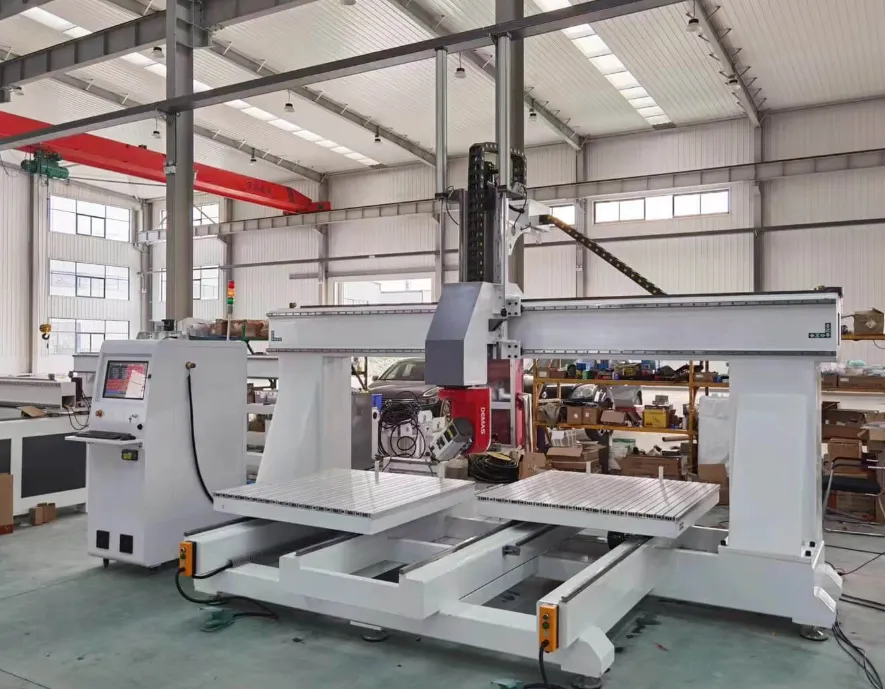
Wood manufacturing has undergone a quiet but significant shift over the past decade. The demand for complex geometry, tighter tolerances, and faster production cycles has pushed many fabricators and product designers away from conventional multi-step milling processes toward more capable machining approaches. For buyers sourcing custom wood components — whether for architectural millwork, custom furniture, cabinetry, theatrical sets, or industrial patterns — the decision about which machining method to use carries real consequences for quality, cost, and schedule.
This guide is written for professionals who are evaluating 5 axis CNC wood machining as a production or prototyping option. It covers how the technology works in practice, where it fits into a production workflow, what buyers should evaluate before committing to a service provider, and how to avoid common sourcing mistakes. The goal is practical clarity, not technical persuasion.
What 5 Axis CNC Wood Machining Actually Involves
Standard CNC routers and mills operate along three linear axes — X, Y, and Z — which allows them to cut depth, width, and length, but always from a fixed orientation relative to the workpiece. Five axis machining adds two rotational axes, which means the cutting tool can approach the material from almost any angle without requiring the operator to manually reposition the part. In woodworking applications, this translates directly into the ability to machine compound curves, undercuts, tapered profiles, and sculptural forms in a single setup.
Buyers who are seriously evaluating 5 axis cnc wood machining services should understand that the value is not simply in the number of axes — it is in what those axes eliminate. Every time a part is repositioned during machining, there is a potential for misalignment. In high-tolerance woodwork, even small registration errors compound across a production run. Five axis machining reduces the number of setups required, which directly reduces the sources of dimensional error.
Simultaneous vs. Indexed Five Axis Cutting
There is an important distinction within five axis machining that buyers often overlook. Simultaneous five axis cutting means all five axes are moving and coordinated during the cut itself. Indexed five axis — sometimes called 3+2 machining — means the machine positions the two rotational axes, locks them in place, and then cuts using the three linear axes. Both approaches are legitimate, but they are not interchangeable for every application.
For organic, flowing surfaces — like sculptural chair backs, custom speaker enclosures, or carved architectural panels — simultaneous movement produces smoother transitions and more consistent surface quality. For parts that have multiple flat or angled faces that need to be machined precisely, indexed five axis is often sufficient and more cost-effective. When requesting quotes or evaluating service providers, understanding which approach they use for a given part type will help align expectations for surface finish, cycle time, and pricing.
Where Five Axis Wood Machining Fits in a Production Workflow
Five axis CNC wood machining is not a universal replacement for conventional routing or joinery. It is most valuable in specific workflow situations where conventional methods either cannot achieve the required geometry or would require so many secondary operations that the total labor cost exceeds the cost of a single five axis run. Understanding where this technology genuinely fits — and where it does not — helps buyers make sourcing decisions that are grounded in operational reality rather than technical enthusiasm.
Prototyping and Design Validation
In product development environments, five axis machining is frequently used to produce physical prototypes of complex geometry before committing to full tooling or production runs. For furniture designers, architects, or industrial product teams, having a precise physical model that reflects actual material behavior — grain direction, surface response to tooling, edge quality — is meaningfully different from reviewing a digital render. Wood responds differently than foam or plastic to the same cutting paths, and five axis machining allows teams to test real material early in the design process.
This use case matters operationally because prototyping cycles directly affect how quickly a product moves from design approval to production release. If a prototype requires multiple rounds of hand-finishing to correct geometry that the machining process couldn’t achieve, that time is absorbed somewhere in the project schedule. A well-executed five axis prototype often reduces that correction time significantly.
Custom and Short-Run Production
For buyers producing custom architectural millwork, one-off furniture commissions, or limited production runs of specialty components, the economics of five axis machining shift considerably compared to high-volume manufacturing. The setup time and programming investment are amortized across fewer parts, which means unit costs are higher — but so is the geometric capability per part. For buyers in this segment, the relevant comparison is not five axis versus conventional CNC, but five axis versus the combined cost of conventional CNC plus handwork plus secondary machining operations.
In many custom millwork applications, a single five axis program can eliminate several hours of skilled hand carving or shaping. The consistency benefit is also material: in a run of matching components for an interior installation, five axis machining delivers identical geometry across every piece in a way that hand-finishing cannot reliably replicate.
High-Complexity Repetitive Production
Some manufacturers use 5 axis cnc wood machining services as part of a repeatable production process for components that have complex geometry but consistent specifications — items like curved stair components, custom speaker baffles, or architectural brackets produced in batches. In this scenario, the programming investment is made once and the process runs repeatedly, which improves unit economics over time while maintaining the geometric accuracy that the product requires.
How to Evaluate a Five Axis Wood Machining Service Provider
The technical capability of a machine is only part of what a buyer is actually purchasing when they engage a five axis wood machining service. Programming quality, material handling practices, tooling selection, and quality verification processes all affect the final outcome. Buyers who evaluate providers based solely on equipment specifications often encounter problems that are actually caused by process gaps, not machine limitations.
Programming and CAM Expertise
Five axis machining requires significantly more complex CAM programming than three axis work. The toolpaths must account for tool tilt, collision avoidance between the cutting head and the workpiece or fixture, and the specific behavior of wood as an anisotropic material — meaning it responds differently to cutting forces depending on grain orientation. A provider with strong five axis programming capability will be able to discuss toolpath strategy for a given part, explain how they manage grain direction relative to cutting direction, and identify potential problem areas in a design before cutting begins.
Buyers should ask to see examples of similar work, and specifically ask about parts that presented programming challenges. How a provider describes problem-solving in their process tells you more about their actual capability than a list of machine specifications. The CAM software and post-processing workflow used by a provider directly affects the quality and efficiency of the output, and experienced providers will be transparent about this part of their process.
Fixturing and Material Handling
Wood is not a dimensionally stable material under all conditions. It responds to humidity, temperature changes, and internal stress in ways that manufactured sheet goods or solid metals do not. A provider working with hardwoods or engineered wood products needs fixturing strategies that account for material movement during and between machining operations. Vacuum tables, custom jigs, and spoilboard management are all part of this equation.
Buyers sourcing 5 axis cnc wood machining services for solid hardwood components should ask specifically how the provider handles material acclimation, how parts are fixtured for five axis work, and what their process is for checking dimensional stability before and after machining. These are not exotic questions — they reflect standard process discipline for anyone doing serious wood machining work.
Quality Verification and Documentation
For buyers integrating machined wood components into larger assemblies — furniture systems, architectural installations, pattern or mold applications — dimensional accuracy at delivery is a real operational risk. A single out-of-tolerance component can delay an installation or require rework that is more expensive than the original part. Providers who have structured quality verification processes — including first-article inspection, in-process checks, and documented measurement of critical dimensions — reduce that risk in a way that providers relying solely on operator judgment do not.
Common Sourcing Mistakes and How to Avoid Them
Buyers new to 5 axis cnc wood machining services frequently encounter avoidable problems that trace back to sourcing decisions made before production began. These mistakes are not unique to wood machining, but the material characteristics of wood make some of them more consequential than they would be in other materials.
• Submitting files that are not optimized for five axis machining, including designs with internal geometries or tolerances that are achievable in other materials but not in wood at the required grain orientation.
• Selecting a provider based on price alone without verifying their experience with the specific wood species or engineered material the project requires, since tooling strategy and cutting parameters differ meaningfully across materials.
• Failing to specify finish requirements clearly, including surface roughness expectations, whether faces will be painted or clear-finished, and how edges and internal corners should be treated.
• Not communicating downstream assembly requirements, which affects how a provider should handle dimensional tolerances on mating surfaces and connection points.
• Assuming a provider’s general CNC capability translates directly to five axis wood experience, since some shops have five axis machines primarily for composites or aluminum and have limited process knowledge for wood-specific applications.
Design Considerations Before Submitting a File
The quality of a five axis wood machining outcome is significantly influenced by decisions made at the design stage. Buyers who invest time in preparing well-structured files and clear specifications reduce back-and-forth with providers, shorten lead times, and get more predictable results. This is especially true for complex organic geometry where design intent can be ambiguous in a 3D file but critical to the finished part.
File Format and Model Quality
Five axis wood machining providers work from 3D surface or solid models, not 2D drawings, for most complex geometry. STEP and IGES formats are widely supported, and clean solid models are preferable to surface models with gaps or non-manifold geometry. Providing both a 3D model and a 2D drawing with critical dimensions called out reduces interpretation errors and gives the programmer a clear reference for what the file is intended to represent.
Grain Direction and Aesthetic Intent
For wood components where grain direction affects appearance, buyers need to specify orientation requirements in writing — not assume the provider will make the same aesthetic judgment they would. A carved panel that is technically accurate but has the grain running in an unexpected direction may be rejected by the end client even if it meets all dimensional specifications. This is a communication responsibility that sits with the buyer, not the provider.
Closing Perspective
Five axis CNC wood machining occupies a specific and valuable position in the broader ecosystem of wood fabrication. It is not the right solution for every project, but for buyers dealing with complex geometry, tight tolerances, or the need for consistent repeatability in custom components, it addresses problems that conventional machining and hand fabrication cannot solve as efficiently or as reliably.
The most productive relationships between buyers and five axis wood machining providers are built on clear communication of requirements, realistic expectations about material behavior, and a mutual understanding of what the process can and cannot deliver. Providers who ask detailed questions before quoting, explain their process transparently, and demonstrate experience with similar work are generally the safest choices — not because they are the least expensive, but because they are the most likely to deliver what the project actually needs the first time.
For buyers still in the evaluation stage, the most useful next step is not to compare prices across providers, but to bring a representative part or project to two or three qualified shops and see how they respond to the specific geometry and material requirements involved. The quality of that conversation will tell you more about provider capability than any equipment list or portfolio.

I’m Leo Knox, the wordplay wizard behind WordsTwists.com where I turn everyday meanings into funny, clever, and creative twists. If you’re tired of saying things the boring way, I’ve got a better (and funnier) one for you!